Row-by-Row Control: A New Standard in Precision Seeding
Seeding is one of those operations where a mistake is not always visible immediately, but almost always becomes costly later. A field may be planted with a modern seeder, high-quality seed, a properly selected seeding rate, accurate guidance, and an experienced operator. Yet if partial blockage, uneven seed flow, or fertilizer flow issues occur in one or several rows, the farm may only discover the problem when it is already difficult – or even impossible – to correct.
That is why precision seeding today is no longer limited to properly setting up the machine before it enters the field. The next level of control is the ability to see what is happening in every row during operation: not after emergence, not after field inspection, not after loss analysis, but at the exact moment when a problem first appears.
Why Flow Monitoring Is Critical
There are no minor details during the seeding campaign. Every row is a separate line of future yield. If the flow of seed or fertilizer stops, decreases, or becomes uneven in that row, the field immediately begins to form a zone of potential loss.
The issue is that such deviations are not always obvious to the operator. The machine continues moving, the work visually appears to be in progress, and the technological operation seems to be performed. But inside the system, a failure may already exist: partial hose blockage, uneven distribution between rows, flow deviation in a specific section, unstable material delivery, or a decrease in overall flow intensity.
For agribusiness, this means not only the risk of uneven emergence. It affects the entire field economy: plant density, competition between plants, fertilizer efficiency, uniform crop development, yield potential, and the quality of subsequent field operations.
In other words, row control is not just an additional technical feature. It is a way to protect the investment already made in seeding.
From Flow Detection to Quality Control
The traditional approach to monitoring was often reduced to a simple question: is there flow or not? But modern precision agriculture requires a deeper level of insight. A farmer needs to understand not only whether seed or fertilizer is being delivered, but also whether there are deviations between rows.
This is where a fundamentally different logic comes in – relative flow monitoring. It makes it possible to detect not only complete blockages, but also partial issues that may be less visible, yet no less dangerous for the final result.
VISUM Seeder RF by J.Assy was developed precisely for this purpose. It is a wireless real-time seed and fertilizer flow monitoring system that provides row-by-row control and immediate detection of deviations. The system allows operators to see not only the presence of flow, but also changes in flow, uneven distribution between rows, and potential issues in material delivery.
How It Works in the Field
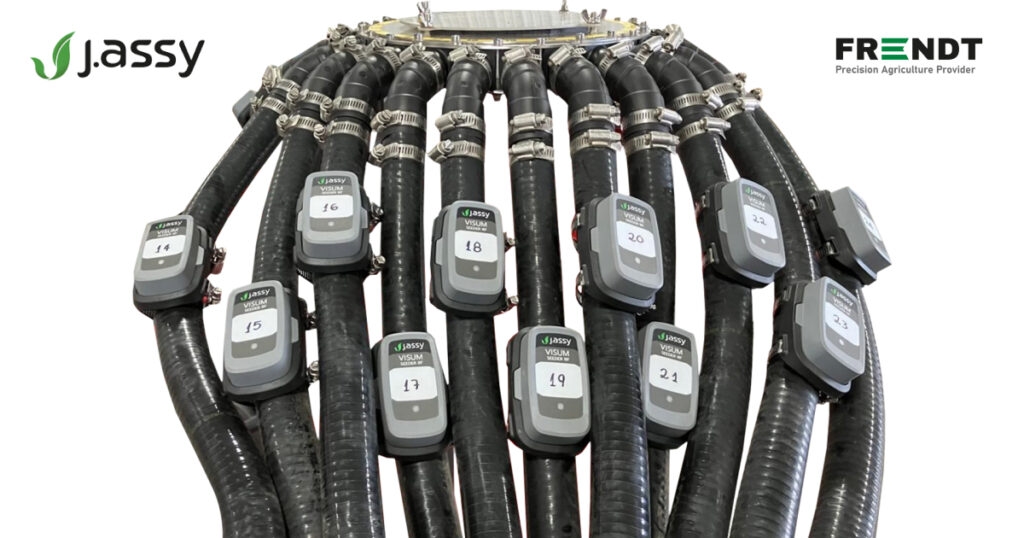
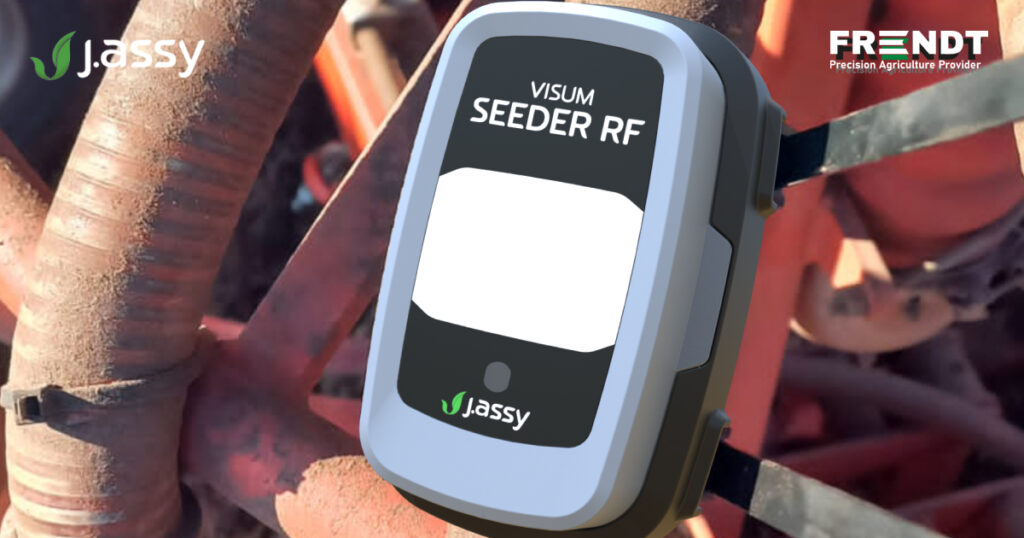
The sensors are mounted externally on the hoses and detect the movement of material. This is an important advantage because the system does not require complex intervention in the hose structure: the sensors are installed externally, without cutting, drilling, or modifying the hoses.
Data from the sensors is transmitted wirelessly to the electronic control unit – the ECU. The system then analyzes deviations between rows and sections, identifies anomalies, and delivers information to the operator through the display. Monitoring is continuous – across every row and throughout the entire system at the same time.
For the operator, this means one simple thing: the problem does not remain hidden. If a failure occurs in a specific row, the system sends an alert, allowing the machine operator to respond before the mistake turns into hectares of uneven seeding.
What VISUM Seeder RF Monitors
The key value of the system lies in its ability to help avoid “blind” seeding. VISUM Seeder RF enables monitoring not only of individual rows, but also of the entire delivery system.
The system helps detect flow disruptions in hoses before they become visible problems in the field, identify uneven distribution, monitor distribution units, detect blockages in entire sections, and respond to a drop in overall flow.
It is also important that the system sends alerts even when the issue may be related not only to an individual hose, but to overall material delivery – for example, a closed or unsecured hopper lid, product bridging inside the hopper, or a general decrease in flow.
In practice, VISUM Seeder RF gives the operator not fragmented information, but a complete picture of machine performance during the operation.
Detecting Deviations Before Complete Blockage
One of the main advantages of VISUM Seeder RF is relative flow analysis between rows. This means the system responds not only when flow has completely stopped. It can also detect deviations when material continues to move, but delivery has become uneven.
These partial blockages are often the most dangerous. They are not always immediately visible, they do not always stop the machine, but they gradually create uneven seeding, emergence problems, and potential yield losses.
VISUM Seeder RF allows these deviations to be detected in real time. As a result, the farmer can not only record the consequences, but prevent the problem while work is still taking place in the field.
Wireless Architecture for Demanding Field Conditions
In field conditions, ease of installation and maintenance is often just as important as functionality itself. Seeding equipment operates in dust, vibration, changing weather conditions, and with a large number of moving and working components. The more complex the system, the more time and resources are required for installation, setup, and maintenance.
VISUM Seeder RF is built on wireless sensor technology. This means there is no need to run cables to every row or complicate the machine structure with additional wiring. The sensor is mounted externally on the hose, does not come into contact with the material, and does not restrict its movement.
This is especially important for farms that do not want equipment upgrades to become a complex engineering project. A system must be technological, but also practical: quick to install, easy to understand, and not create unnecessary pressure on the team during the season.
System Components
VISUM Seeder RF is not just a single sensor, but a complete solution for monitoring seed and fertilizer flow.
The system includes universal VISUM Seeder RF sensors, which are mounted on hoses using clamps and are used to monitor the flow of seed or fertilizer. The central element of the system is the ECU Seeder V24 electronic control unit, which receives data from the sensors, analyzes it, and sends information to the operator’s display.
Different cable kit options are available for system connection: ISOBUS 4.8 m, ISOBUS 10.9 m, ISOBUS 16.7 m, an ISOBUS Y-cable, as well as adapter cables for Ag Leader, Raven, and John Deere.
This means the system combines wireless sensor operation with practical compatibility across various displays and platforms already used on farms.
Technical Capabilities
VISUM Seeder RF can monitor up to three independent delivery flows – for example, seed and fertilizer – and up to 120 rows per product. This makes the system relevant not only for basic seeding control, but also for more complex machine configurations where it is important to monitor several flows simultaneously.
The system operates with an electronic control unit powered by 10-30 V, features protection against dust, water, and corrosion, and the sensor battery life is approximately 4,000 hours. It is ISOBUS-compatible, allowing information to be displayed on the machine’s standard terminal, and can also work with Ag Leader, Raven, and John Deere solutions.
VISUM Seeder RF is adapted for working with different small-seeded crops and can be used on hoses with diameters from 2.5 to 10 cm.
The Role of the Operator Is Not Reduced – It Is Strengthened
It should be said honestly: no system replaces the attentiveness and professionalism of the machine operator. But modern technologies give operators what they previously lacked most – visibility into the process.
An operator cannot physically monitor every hose, every row, and every change in flow while the machine is moving. Their role is to manage the process, respond to deviations, and maintain the quality of the operation. The monitoring system takes over the technical part of control and immediately shows exactly where the problem has occurred.
This is the right logic of automation in agriculture: it does not remove the human from the process. It makes human decisions faster, more precise, and better informed.
Practical Results for the Farm
The main cause of losses during seeding is lack of control. When a farm cannot see what is happening in every row, it is essentially working on the assumption that everything is going correctly. But in the field, assumptions are expensive.
VISUM Seeder RF provides full process transparency, reduces dependence on the human factor, and turns seeding from a simple technological operation into a controlled system. The system helps eliminate skips during seeding, avoid unseeded zones, ensure uniform emergence, and reduce resource losses.
Most importantly, it allows the problem to be detected before it becomes visible in the field. Not after emergence. Not after yield potential has been lost. Not when the situation can no longer be corrected. But exactly at the moment when the operator can still intervene and preserve the quality of the operation.
Control That Shapes Seeding Quality
For agricultural producers, the seeding campaign always takes place under time pressure. Weather windows are short, machinery must operate productively, and every stop must be justified. That is why real-time monitoring is becoming not a luxury, but an element of production safety.
When a farmer sees what is happening in every row, they receive more than just data. They gain confidence that the technological operation is being performed properly. And if a problem occurs, it can be localized, eliminated, and work can continue without the accumulation of hidden losses.
In modern precision agriculture, the final result is formed not by one large action, but by hundreds of small, controlled decisions: a straight pass, a stable application rate, precise placement, correct depth, and control of every row. These are the details that create a field that works for profit.
VISUM Seeder RF is a solution for farms that want to see seeding not approximately, but precisely. Not to wait until a problem appears in crop emergence, but to detect it at the moment it occurs. Not just to perform an operation, but to control its quality in real time.
That is why row-by-row control is no longer an additional convenience. It is a new standard in precision seeding, where every meter of the field matters, and every line of future yield must remain under control.