A Large Land Bank ≠ Efficient Farming
Why scale no longer guarantees results and how the economics of agriculture are changing
Ten to fifteen years ago, the size of a land bank was the key indicator of a farm’s strength. The more hectares — the higher the potential revenue, the greater the opportunities for optimization, and the stronger the market position.
Today, this logic no longer applies.
The market has changed, and with it, the very nature of efficiency.
In practice, large-scale farms often face the opposite effect: as acreage increases, so do not only potential profits, but also the scale of losses. The root cause is the lack of precise control.
This is clearly illustrated when comparing two approaches:
| Indicator | Without digital solutions | With precision agriculture technologies |
|---|---|---|
| Overlaps during field operations | 5–10% | 0–2% |
| Input overuse (crop protection & fertilizers) | 10–25% | 3–7% |
| Missed areas during seeding | up to 8% | <2% |
| Human factor | high | minimized |
| Process control | partial | full |
| Predictability of results | low | high |
Even seemingly minor losses of around 5% on a 1,000-hectare farm translate into significant financial losses every year.
Where the losses actually occur
Losses in agricultural production are rarely obvious — they are distributed across the entire production cycle and accumulate over time.
During seeding, the key issues include uneven plant density, skips or overlaps in rows, and inconsistent seeding depth, all of which directly affect crop emergence.
At the fertilization stage, losses arise from uneven distribution, over-application or under-application, as well as the lack of flow control. As a result, resources are used inefficiently.
During crop protection operations, the main sources of loss are overlaps, skips, and dependence on human factors, leading to overuse of inputs and reduced treatment effectiveness.
At harvest, the absence of accurate yield mapping and analytics prevents meaningful feedback, limiting the ability to improve decisions for the next season.
Scale as a risk factor
A mistake on 100 hectares is a localized issue.
The same mistake on 1,000 hectares becomes a systemic loss.
As farm size increases, control becomes more complex, reliance on personnel grows, and the cost of each inaccuracy rises.
In this context, scale without proper management becomes a risk factor rather than an advantage.
Why farmers are not unlocking their full potential
Despite the availability of modern technologies, many farms continue to operate under traditional models. This is driven by a lack of trust in new solutions, resistance to change, and the absence of a clear implementation strategy.
In many cases, technologies are introduced without a systematic approach — or worse, implementation begins with equipment rather than identifying actual problems.
How efficiency changes: numbers and logic
Consider a typical 1,000-hectare farm.
In a traditional model, input losses can reach approximately 15%, while yield losses may range from 5–10%. Without proper analytics, these losses often go unnoticed, translating into $70–200 per hectare.
With a systematic approach, overlaps are reduced, operations become more stable, and input application is controlled. This allows farms to decrease input costs by 10–20% and increase yields by 5–10%, resulting in an economic gain of $100–250 per hectare.
Precision agriculture as a management system
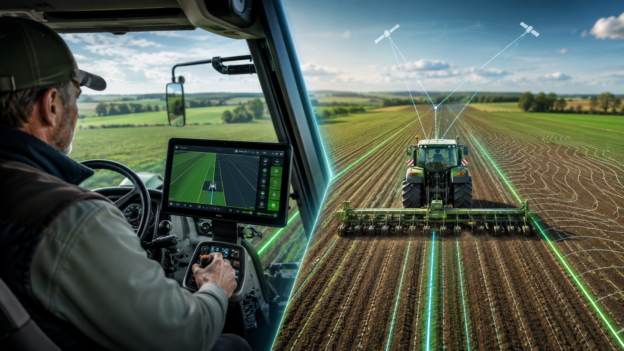
Precision agriculture is not just a set of tools — it is a management philosophy based on data.
It involves identifying losses, collecting and analyzing data, implementing solutions, and continuously monitoring results.
This is not a one-time action, but an ongoing process that ensures stability and predictability.
Comparing approaches
In traditional farming, decisions are primarily based on experience, while in a systematic approach they are driven by data. Control in the traditional model occurs after operations are completed, whereas in precision agriculture it takes place in real time.
Efficiency in traditional systems is often unstable and dependent on multiple variables, while a data-driven approach ensures predictable outcomes. Costs in conventional farming are frequently uncontrolled, whereas digitally managed farms track and optimize them precisely.
When it comes to scaling, traditional models struggle due to a lack of transparency and control, while systematic operations allow for structured and manageable growth.
A large land bank is merely a resource. Efficiency depends on how effectively that resource is managed.
Today, results are not determined by the number of hectares, but by the system used to manage them.
And that system is known as precision agriculture.