Agriculture 4.0 and Precision Farming: How Data, Technology, and Accuracy Are Shaping a New Agricultural Reality
Global agriculture is entering a period of profound transformation. Population growth, increasing demand for food, climate instability, soil degradation, and the limited availability of natural resources are forcing the agricultural sector to rethink its production approaches. According to international forecasts, by the middle of the 21st century humanity will need to produce significantly more food than today, while using fewer resources and ensuring a much higher level of environmental responsibility.
In response to these challenges, a new technological model of agricultural development is emerging, increasingly referred to as Agriculture 4.0. This concept reflects the deep integration of digital technologies, automation, bioengineering, and data analytics systems across all stages of agricultural production – from crop planning to logistics and product distribution.
However, the key element of this transformation is precision farming. It has become the practical tool for implementing the principles of Agriculture 4.0 directly in the field. Precision farming enables the transition from a traditional farming model to a system where every hectare, every operation, and even every technological action is driven by data.
Historically, conventional agriculture has been shaped as a system heavily dependent on farmers’ experience, weather observations, and intuitive decision-making. Fields have often been treated as homogeneous areas, where uniform rates of fertilizers, seeds, and crop protection products are applied across the entire surface.
However, modern soil and agronomic research shows that even within a single field there can be significant variability in soil fertility, soil profile structure, moisture levels, nutrient availability, and yield potential. These differences often result in uneven crop development and yield variability across the field. As a result, traditional approaches lead to resource overuse in some areas and underutilization of potential in others.

Precision farming technologies make it possible to fundamentally change this logic. Through advanced data collection systems, farmers gain a detailed understanding of field variability and can adapt crop management practices to the specific conditions of each zone.
At the core of the Agriculture 4.0 concept lies data. Modern agricultural enterprises increasingly resemble complex digital systems, where every production process is accompanied by data collection.
Today, a wide range of data sources is used, including satellite imagery, unmanned aerial vehicles, soil moisture and temperature sensors, weather stations, sensors installed on agricultural machinery, and yield mapping systems.
These tools generate large volumes of data about field conditions. Based on this data, yield maps, productivity maps, and variable-rate application maps are created, forming the foundation for informed agronomic decision-making.
This enables farmers to manage production not at the field level, but at the level of specific productivity zones.
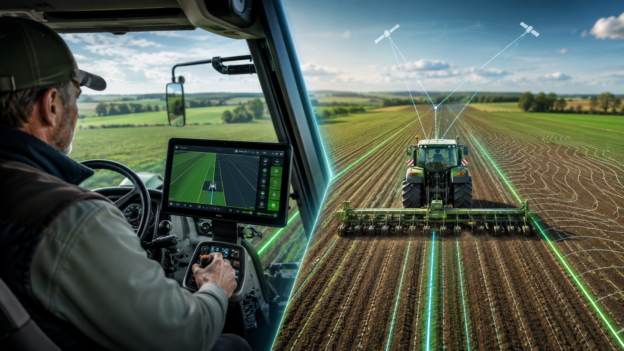
One of the fundamental components of precision farming is high-accuracy navigation. Modern GNSS technologies, combined with RTK correction signals, provide positioning accuracy at the centimeter level. This opens up entirely new possibilities for managing field operations.
Autosteer systems allow farmers to minimize overlaps during field operations, avoid skips during seeding and input application, optimize fuel consumption, reduce operator fatigue, and ensure consistent execution of technological processes.
As a result, even a single operation can generate measurable savings. Over the course of a full agricultural season, the cumulative effect of such technologies can be substantial. Additionally, autosteer systems enable operations under low-visibility conditions – at night, in dust, or in fog – increasing machinery utilization during peak periods.
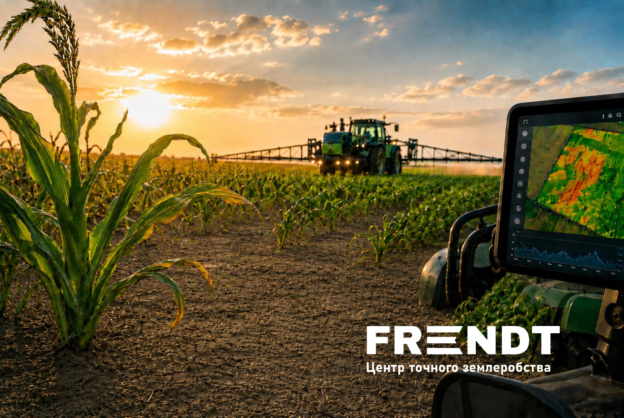
Another key element of precision farming is variable-rate application. Using productivity maps, farmers can identify areas with higher yield potential and those that require more conservative resource management.
In practice, this means that higher rates of fertilizers can be applied in high-potential zones, while lower rates are used in weaker areas. Seeding rates are adjusted according to the productivity potential of each zone, and crop protection products are applied more precisely.
This approach not only reduces input costs but also increases overall field productivity, as each zone receives the optimal level of inputs required for its specific conditions.
Another important direction of Agriculture 4.0 development is the use of artificial intelligence and machine learning. Modern digital platforms are capable of analyzing vast amounts of agricultural data and generating actionable recommendations for agronomists.
Artificial intelligence can be used to forecast yields, determine optimal timing for field operations, assess risks of disease development, plan resource use, and optimize production processes. As a result, farmers gain a powerful tool for making more informed and timely decisions.
Technological transformation is also reshaping the way food is produced. One example is the development of vertical farming – a technology that enables crop production in stacked layers within controlled environments.
Such systems allow year-round production, significantly reduce water consumption, minimize the use of pesticides, and enable food production closer to urban centers.
In parallel, biotechnology is advancing rapidly, enabling the development of new crop varieties with improved resistance to drought, heat, and other stress factors.
All these changes are gradually transforming the role of humans in agriculture. Modern farmers rely less on intuition and more on data, digital platforms, and analytical systems. In essence, they are becoming managers of complex technological ecosystems that integrate agronomy, engineering, IT, and economics.
Ultimately, Agriculture 4.0 is shaping a new model of agricultural development in which precision in resource management, digital technologies, data analytics, automation, and environmental responsibility play a central role.
Precision farming has become the foundation of this transformation, enabling the integration of technology, data, and agronomic expertise into a unified management system.
In the coming decades, these approaches will define the competitiveness of agricultural enterprises. Farms that successfully integrate digital tools, navigation systems, and data-driven decision-making into their operations will gain a significant advantage in the global agricultural market.
In other words, the future of agriculture is already being shaped today – and its defining characteristic is precision.