Digital Transformation in Agriculture: How FRENDT Technologies Enable Centimeter-Level Field Management
The agricultural sector is entering a period where profitability depends less on farm size and increasingly on the quality of management. Input costs are rising, weather risks are intensifying, labor shortages are becoming systemic, and markets demand stability and predictability. In these conditions, it is not those who “work harder” who win, but those who manage processes more precisely. This managerial transformation is exactly what FRENDT – Precision Agriculture Center – delivers.
The company operates not in the realm of selling individual devices, but in restructuring the logic of agricultural production – shifting from an intuitive model to a management system built on digital solutions and data.

For many years, classical agronomy relied on average values. In reality, however, a field is a mosaic of zones with varying soil fertility, moisture availability, structure, and yield potential. Even within a single field, differences in yield potential can reach 20-40%.
Averaging hides losses: in some areas inputs fail to deliver returns, while in others they are chronically insufficient. FRENDT helps farms move into the realm of precision agriculture, where each field section is analyzed individually. As a result, farmers begin managing not “the field as a whole,” but the potential of each of its zones.
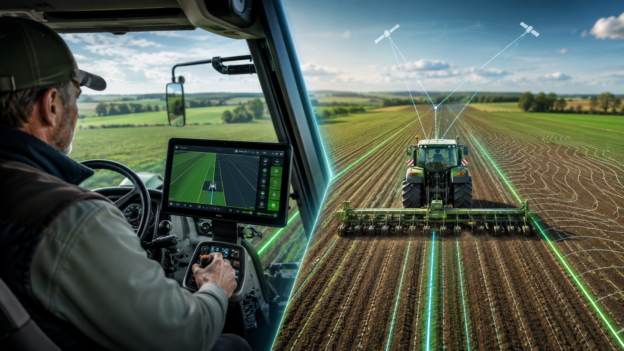
No digital strategy works without stable georeferencing. FRENDT implements high-precision RTK-based navigation solutions that ensure machine positioning accuracy of 2-3 cm.
The practical impact is reflected in measurable production results:
- reduction of overlaps during seeding and application by 5-15%;
- elimination of skips that cause uneven crop emergence;
- consistent implement working width across the entire field;
- the ability to precisely return to the same tracks;
- optimization of operation time by 10-12%.
This creates a geometry of precision, which becomes the foundation of the economic performance of every hectare.
Agriculture remains one of the industries where the human factor has a decisive impact on final results. Fatigue during long shifts, night work, varying operator experience, and subjective perception of field conditions inevitably lead to fluctuations in work quality. These factors are often responsible for uneven operations, overlaps, input overuse, and productivity losses during the most critical periods of the season.
Automatic steering systems implemented by FRENDT change this approach by ensuring a stable and predictable machinery trajectory regardless of human influence. Machines operate with the same precision throughout the entire working day, under any lighting conditions and field complexity. This standardizes the quality of agronomic operations and makes results repeatable from field to field and season to season.
Precise guidance reduces overlaps and skips, directly saving seeds, fertilizers, and crop protection products. At the same time, equipment efficiency increases: during peak fieldwork periods, productivity rises on average by 8-15%, while fuel consumption decreases by 5-10%. Equally important is the human aspect – automated steering significantly reduces physical and psychological strain on operators, allowing them to focus on process monitoring rather than constant manual control.
In this model, automation does not replace people – it becomes a tool for stabilizing production, helping agricultural enterprises shift from reliance on individual operator experience to a systematic, controllable, and predictable quality of machine operations.
One of the key changes FRENDT brings to farms is the transition to systematic use of agricultural data. Information on yield, soil parameters, and field operations ceases to be formal reporting and becomes the basis for strategic planning.
Farms gain the ability to:
- analyze productivity of individual field zones;
- compare technology performance across seasons;
- adjust crop nutrition and protection strategies;
- forecast seasonal outcomes based on actual data.
In precision farming practice, the use of yield maps and soil analytics increases fertilizer use efficiency by 10-20% on average without increasing the total budget.
Data becomes a management language that unites agronomy and economics.
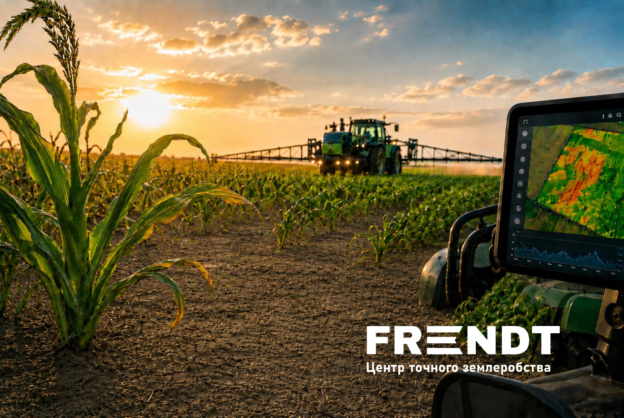
Based on spatial analytics, FRENDT enables farms to move to variable-rate application. Seed, fertilizer, and crop protection rates change within the same field according to the potential of each zone.
This approach provides:
- reduction of input overuse in low-potential zones by up to 15-25%;
- improved return on investment in high-productivity areas;
- more uniform crop development;
- yield stabilization across the field.
As a result, expenses stop being a fixed cost item and become a flexible tool for yield management.
One of the key advantages of the FRENDT approach is the ability to seamlessly integrate modern solutions into a farm’s existing machinery fleet. This allows precision agriculture technologies to be introduced gradually, without the need for complete equipment replacement or a sharp increase in investment burden.
Integration of FRENDT systems makes it possible to modernize existing machines, increasing their precision and efficiency without altering their core construction. Farms can continue using familiar equipment while expanding its functionality and improving operational control. This lowers the financial entry barrier to digital farming and makes advanced technologies accessible not only to large agricultural holdings, but also to medium and small producers.
Phased implementation allows capabilities to grow progressively – from basic automated steering to more advanced precision farming elements, depending on farm needs and strategic goals. This ensures flexibility, minimizes risks, and gives farmers full control over the transformation process, turning digitalization into a structured development path rather than a one-time project.
Digital transformation thus becomes not a single expense, but a managed step-by-step process with predictable return on investment.
Technologies deliver value only when personnel know how to use them. FRENDT places strong emphasis on training farm specialists and providing ongoing service support. This allows farms to:
- shorten the adaptation period to new systems;
- avoid implementation errors;
- maintain stable system performance during the season;
- build internal digital competence.
As a result, technologies become part of the farm’s operational culture rather than a temporary experiment.
Farmers’ main interest in FRENDT lies in long-term impact. Precision, automation, and analytics do not merely optimize individual operations – they form a resilient economic model for the farm.
This enables farms to:
- plan budgets more accurately;
- reduce dependence on input price volatility;
- stabilize yields under challenging conditions;
- improve overall business manageability.
FRENDT attracts farmers by moving agricultural production from the realm of experience and intuition to that of measurable processes, controlled decisions, and predictable outcomes. The field ceases to be a zone of uncertainty and becomes a managed system where technology, data, and people work in sync to achieve stable efficiency.