Precision Agriculture: How Data, Technology, and Automation Are Transforming Field Economics
Today, in the context of agricultural efficiency, data, accuracy, and the ability to manage every square meter of a field play a decisive role. This is the foundation of precision agriculture – a modern approach to farming that integrates technology, analytics, and automation to achieve stable agronomic and financial outcomes.

What Is Precision Agriculture
From an innovation perspective, precision agriculture is an agricultural method based on the use of advanced digital and navigation technologies to optimize all field operations. Its core principle is to ensure that plants receive exactly the resources they need, in the required amounts, without overuse or loss of efficiency.
From a financial standpoint, precision agriculture combines a farmer’s professional expertise with technology to allocate resources rationally and increase production profitability. Management shifts from a “one-size-fits-all field” approach to managing specific productivity zones and individual field areas.
At the heart of this system lies a continuous cycle: data collection, data processing, creation of prescription maps, automated execution of operations, quality assessment, and decision adjustment. As a result, a predictable model of yield and product quality is formed.
Key Concepts of Precision Agriculture
GNSS and RTK
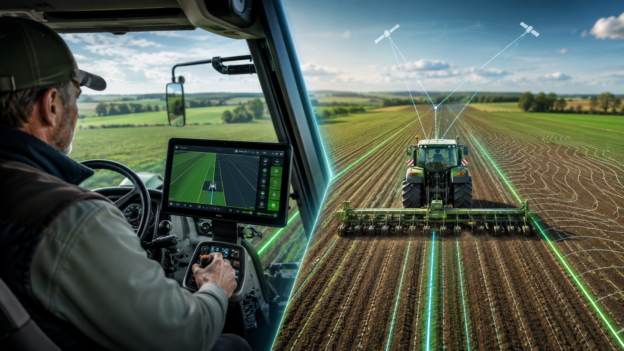
GNSS refers to satellite navigation systems that determine the position of machinery in the field. For agriculture, RTK (Real Time Kinematic) technology is critical, as it improves positioning accuracy to 2-2.5 cm. The RTK component enables highly repeatable operations – from pre-sowing tillage to harvesting – without overlaps or skips.
Guidance Systems and Autosteer
A guidance system is the simplest and most affordable solution that helps the operator manually control the machine’s trajectory. The operator inputs the implement working width and sets the starting coordinates, and after the first pass, defines the endpoint. The device analyzes the data, generates parallel guidance lines, and displays them on the monitor. The next level of accuracy beyond guidance systems is the installation of an autosteer system that can control the machinery automatically.
Autosteer is an automatic steering system that reduces the human factor and ensures consistent work quality. It can operate using free, paid, or RTK correction signals. Even a basic level of automation increases field operation efficiency by several percent, which translates into a tangible economic effect over the course of a season.
Soil Agrochemical Analysis
Soil agrochemical analysis provides farmers with a comprehensive picture of field conditions, enabling precise determination of pH levels as well as macro- and micronutrient availability. Based on this data, informed decisions can be made regarding crop nutrition systems. This directly reduces fertilizer overuse, increases the efficiency of every applied input, supports stable yield growth, preserves and restores soil fertility, and forms a solid foundation for implementing precision agriculture and achieving predictable, economically justified results.
Yield Maps and Productivity Zones
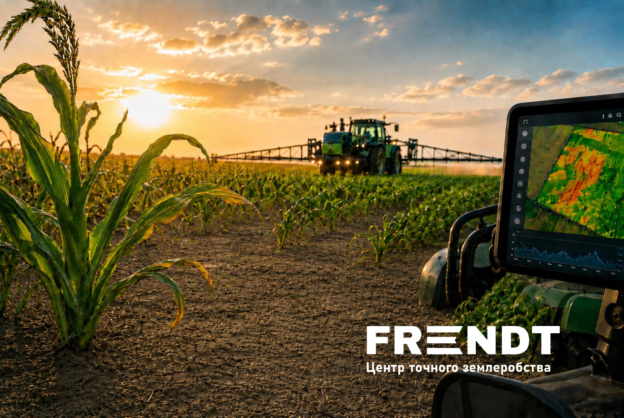
Yield monitoring delivers spatial data on actual field performance. Based on this information, productivity zones are identified, showing where crop potential is high and where it is constrained by soil, terrain, or technological factors. This serves as the basis for making precise agronomic decisions.
Variable-Rate Application and Seeding
Prescription maps for variable-rate application of fertilizers, seeds, or crop protection products allow application rates to be adjusted within a single field. This approach ensures material savings while maintaining or increasing yields, as each zone receives the optimal amount of nutrients.
The Economic Value of Precision Agriculture
The economic impact of implementing precision agriculture varies depending on farm scale, but the principle remains the same – cost reduction and improved business manageability.
For Small Farms
Precision agriculture enables maximum efficiency even with limited budgets. Individual elements such as digital field boundaries, basic parallel guidance, or soil agrochemical testing help avoid overuse of inputs, improve procurement planning, and stabilize financial performance.
For Medium-Sized Farms
Farms that cannot expand their land bank gain a tool for intensive development. Resource optimization, automation of operations, and the use of prescription maps allow yields to increase without proportional cost growth while reducing dependence on the human factor.
For Agricultural Holdings
In large-scale structures, precision agriculture becomes the foundation of data-driven management. Real-time operational control, centralized data storage, quality assessment of field operations, and result forecasting make it possible to coordinate activities across thousands of hectares and increase overall business capitalization.
Precision agriculture is not a one-time investment or a collection of isolated technologies; it is a systemic approach to managing agricultural production. It integrates agronomy, machinery, and analytics into a single model where every decision is data-driven. In a world of rising costs, climate risks, and intensifying competition, accuracy, automation, and predictability become the decisive factors for the success of modern agribusiness.