Repair and Maintenance of Agro-Electronics: How to Extend the Life of Navigators, Receivers, and Autopilots
Modern agribusiness is built not only on machinery but also on data. Satellite navigation, automatic steering systems, GNSS receivers, field monitors, and sensors form the digital foundation of a farming enterprise. They determine seeding accuracy, fertilizer and fuel savings, spraying efficiency, and harvesting productivity.
However, like any equipment, agro-electronics can malfunction or fail. Sometimes these are minor issues that can be detected in the field, and sometimes – serious breakdowns that require professional intervention. The good news is that most of these problems can be solved quickly and without purchasing new equipment.
Proper diagnostics, timely maintenance, and professional repair significantly extend the lifespan of agro-electronics and help save the farm’s budget.
Common Problems of GNSS Receivers and Navigators
1. Signal and Correction Failures
One of the most common field situations is when the navigator shows only floating accuracy (RTK FLOAT) and does not switch to FIX mode.
Possible causes:
- lack or instability of correction signal (NTRIP, radio modem, mobile internet);
- multipath interference – reflection of signals from metal structures or trees;
- incorrect port or baud rate settings in the receiver.
Example: if the receiver detects 12 satellites but accuracy fluctuates within 50-80 cm, the first things to check are correction signal availability and antenna cable integrity.
2. Hardware Damage
GNSS receivers and navigators operate in harsh conditions – dust, moisture, and temperature fluctuations.
Moisture entering the unit often causes board corrosion and sudden shutdowns.
Even a small crack in the antenna cable can lead to a loss of 1-2 dB in signal strength, which is critical for RTK accuracy.
Oxidized connector contacts can cause “ghost” errors when the system operates erratically for no apparent reason.
Example: if a navigator freezes intermittently, checking power supply and connectors often helps sooner than reinstalling firmware.
3. Software Errors
Equally common are software-related issues.
Outdated firmware may cause compatibility conflicts with newer systems.
Incorrect port configuration or RTCM format can prevent correction data reception.
Internal clock failures may disrupt steering timing.
Example: if a navigator loses connection after a base station update, the receiver firmware may need to be upgraded to support the new protocol.
Autopilots: When the Machine “Waves” on the Field
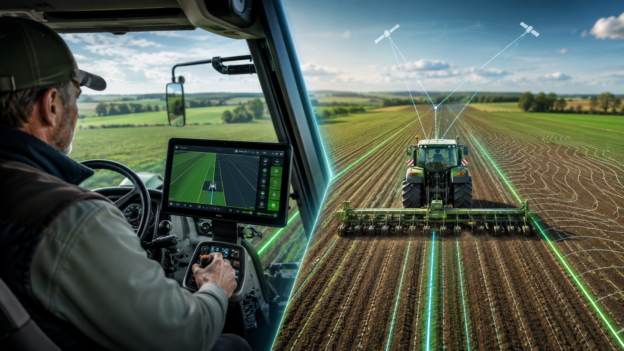
An autopilot is the key to fuel savings and perfectly straight rows — but it can also misbehave:
- “fish tailing” – a side-to-side oscillation when the tractor or combine moves in wave-like patterns;
- delay when entering a guidance line;
- unstable course at high speeds.
Possible causes:
- improper IMU or wheel angle sensor (WAS) calibration;
- looseness in hydraulic or mechanical components;
- incorrect tuning parameters (aggressiveness, sensitivity).
Example: if the machine continues to move in a wavy pattern even after recalibration, check for play in the steering rods and pressure in the hydraulic lines.
Mechanical Failures: Displays, Housings, and Connectors
Not all autopilot problems are electronic. Mechanical failures are also common:
- broken navigator display;
- cracked autopilot housing;
- worn-out or jammed buttons;
- damaged power or antenna connectors.
Many farmers assume such issues mean buying a new system. However, at the FRENDT service center, displays are restored, housings repaired, connectors replaced, and circuit boards cleaned of moisture.
As a result, the equipment works like new – but costs several times less.
ISOBUS and Equipment Connection Issues
When a terminal does not “see” a sprayer or seeder, the issue is often in the communication bus:
- damaged cable or missing termination;
- address conflicts on the CAN bus;
- faulty ISOBUS connectors.
Diagnosing such issues at the FRENDT service center takes little time and is far more cost-effective than the “trial and error” approach or prolonged equipment downtime in the field.
When to Contact a Service Center
Self-diagnostics are helpful, but there are situations where professional assistance is essential:
- recurring RTK errors even in open fields;
- moisture inside the unit or signs of corrosion;
- critical autopilot errors affecting safety;
- constant ISOBUS disconnections or device dropouts;
- physical damage to displays, housings, or connectors.
In such cases, quick intervention is crucial to avoid halting the entire production process.
FRENDT Services: Repair Instead of Replacement
FRENDT provides comprehensive agro-electronics maintenance services, including:
- repair and replacement of displays and sensors;
- restoration of housings and mounting brackets;
- replacement of connectors and cable assemblies;
- cleaning and restoration of boards after moisture damage;
- diagnostics and repair of hydraulic autopilot blocks;
- inspection, calibration, and software updates;
- servicing and restoration of ISOBUS and CAN bus systems.
This approach allows farms to avoid unplanned expenses and keep their equipment running like new.
How to Extend the Life of Agro-Electronics: Practical Tips
- Regularly inspect cables and connectors – keep them clean from dust and moisture.
- Ensure antennas are installed in open areas with no metal obstructions.
- Store equipment properly – in a dry room and protective cases.
- Perform seasonal calibrations after equipment repairs or tire changes.
- Update firmware and back up configuration files regularly.
- Train operators thoroughly – most failures occur due to user mistakes.
Agro-electronics are an investment that determines the accuracy and profitability of modern farming. While breakdowns may seem catastrophic, in most cases they do not require buying new equipment.
Timely diagnostics, proper care, and quality repairs give systems a second life.
At FRENDT, we prove every day: even a broken display or damaged housing is not the end. Regular maintenance keeps farms running smoothly, reduces unnecessary costs, and lets farmers focus on what truly matters – high yields and business growth.