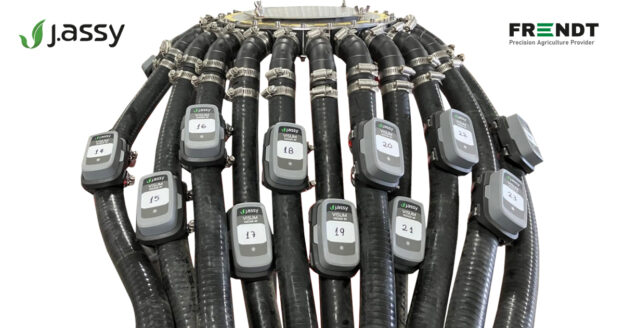
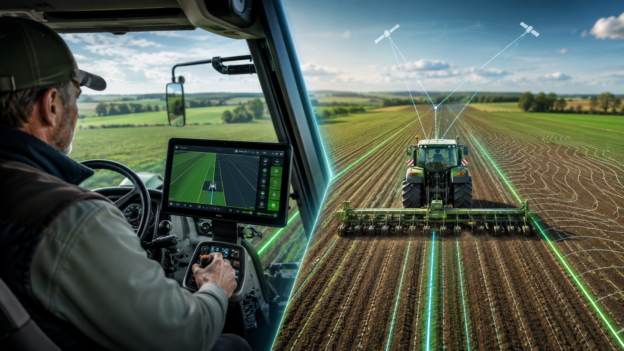
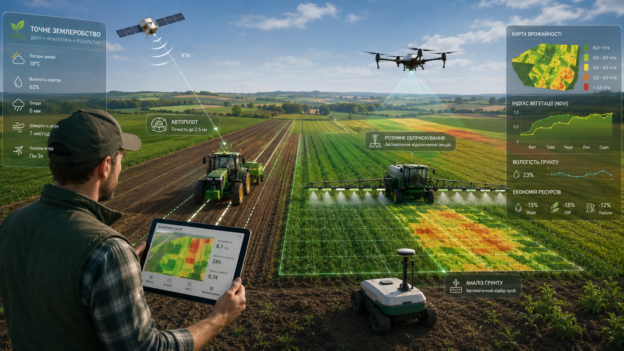
Sprayer Retrofit: Section, Individual Nozzle, and Hybrid Control
Modern spraying accuracy depends not only on nozzles, pressure, or boom condition. Equally important is how precisely the machine determines when to start and stop application, responds to changes in speed, and controls individual parts of the working width.
These are exactly the tasks addressed by a sprayer retrofit – upgrading an existing machine with satellite positioning systems, electronic controllers, sensors, valves, and software.
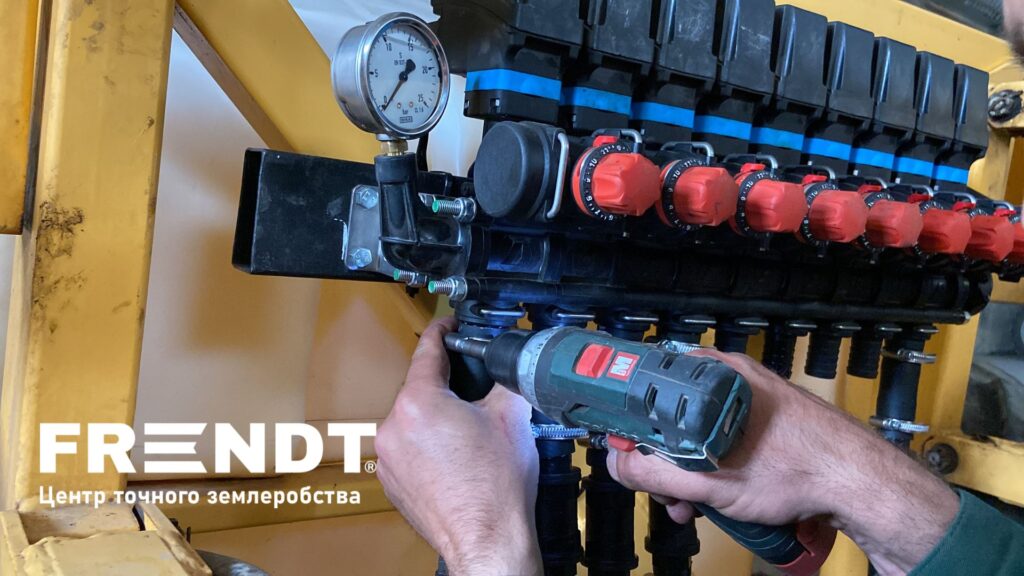
FRENDT offers three main retrofit configurations:
- section control;
- individual nozzle control;
- hybrid control.
The systems are built using Hexagon solutions, while each configuration is selected according to the sprayer model, boom width, fluid delivery system design, field geometry, and the required level of automation.
What Does a Sprayer Retrofit Change?
On a sprayer without automatic control, the operator decides manually when to start and stop the flow of spray solution. On straight passes, this is relatively straightforward, but the situation changes on headlands, wedges, irregular field boundaries, and around obstacles.
Under these conditions, part of the boom may be positioned over an area that has already been treated, while another part is still operating over an untreated area. Switching off the entire boom would create a skip, while continuing to spray would result in an overlap.
An automated system uses the machine’s position and the coverage map to control application precisely where it is required.
Depending on the configuration, a retrofitted sprayer can:
- automatically switch individual boom sections on and off;
- control individual nozzles;
- maintain the target application rate;
- compensate for changes in travel speed;
- generate a map of the treated area;
- record the parameters of completed operations;
- operate via ISOBUS or a standalone controller.
In other words, retrofitting does not change the purpose of the sprayer – it changes the accuracy and the way application is controlled.
Section Control: Automating Individual Parts of the Boom
With a section-control retrofit, the sprayer boom is divided into several independently controlled zones. When a particular section enters an area that has already been treated, the flow of spray solution to that section is automatically stopped. The other sections continue operating.
For example, a 24-metre boom can be divided into several sections of different widths. The narrower each section is, the more precisely the system can follow the field boundary.
Solutions such as Hexagon Sprayer Control can be used for these tasks, providing automatic section control and application rate control in combination with Hexagon field displays.
Key Benefits of Section Control
A section-control retrofit makes it possible to:
- automate the switching on and off of individual parts of the boom;
- reduce repeated application on headlands and wedges;
- reduce the operator’s workload;
- work more precisely along field boundaries;
- generate a map of the area actually treated;
- upgrade existing equipment without immediately moving to full individual-nozzle control.
Its main limitation is the width of the section. If only one nozzle is positioned over an already treated area, the system still controls the entire section.
For this reason, section control is particularly well suited to farms with large, relatively regular-shaped fields or as a first stage in sprayer automation.
Individual Nozzle Control: Controlling Each Nozzle Separately
An individual-nozzle system operates with a much smaller controlled zone – a single nozzle.
If only one nozzle passes over an area that has already been treated, the system can switch off that nozzle alone while keeping the adjacent nozzles operating.
Specialised ARAG components are used to implement this principle, including the SELETRON system. Electronic valves are installed directly on the nozzle holders and controlled via CAN-Bus.
With a standard nozzle spacing of 50 cm, the smallest controlled width can effectively correspond to the operating width of a single nozzle.
This is particularly important on:
- wedge-shaped fields;
- areas with curved boundaries;
- short runs;
- fields with a large number of obstacles;
- wide-boom sprayers.
An individual-nozzle system does not necessarily provide only an “on/off” function. Depending on the equipment, it may offer additional control capabilities, which is why the exact range of required functions should be defined when selecting the system configuration.
Hybrid Control: Accuracy Where It Matters Most
Full individual-nozzle control across the entire boom is not necessary for every farm.
In some cases, the optimal solution is a hybrid retrofit, combining section and individual-nozzle control.
For example, the central part of the boom can operate using conventional sections, while the outer zones use individual nozzle control. It is the outer sections of the boom that are most often the first to enter an overlap zone during turns or when working along irregular field boundaries.
This approach makes it possible to:
- improve accuracy in the most problematic areas of the boom;
- avoid equipping every nozzle with a separate electronic valve;
- adapt the system to the specific geometry of the machine;
- balance system functionality and project cost.
The term “hybrid control” should therefore be understood as a customised system architecture rather than a single standard factory kit.
Application Rate Control: A Separate System Function
Automatic section shut-off and application rate control are often perceived as a single function, although they manage different processes.
Section or nozzle shut-off determines where the spray solution should be applied.
Application rate control determines how much should be applied per hectare.
For example, if the operator reduces or increases travel speed, the system must adjust the flow accordingly so that the actual application rate remains as close as possible to the target rate.
This requires:
- a speed signal;
- a flow meter;
- a regulating valve;
- a controller;
- application parameters entered by the operator.
In Hexagon systems, section control can work together with application rate regulation, making it possible to control both where and how much product is applied.
The Roles of Hexagon and ARAG in the System
A sprayer retrofit does not consist of a single device. It is a combination of components, each performing a specific function.
Hexagon
Hexagon equipment can be used for:
- satellite positioning;
- displaying coverage maps;
- automatic section control;
- application rate control;
- operation through a field terminal;
- ISOBUS communication;
- documentation of completed operations.
Projects may use Hexagon displays and HxGN AgrOn Sprayer Control, depending on the required functionality.
ARAG
ARAG equipment includes specialised components for spraying systems, such as:
- controllers;
- electric valves;
- flow meters;
- sensors;
- nozzle holders;
- section control systems;
- individual nozzle control systems;
- ISOBUS components.
Of particular importance for individual-nozzle retrofits is ARAG SELETRON, which enables independent control of individual nozzles.
Depending on the technical architecture of a particular sprayer, equipment from these brands can be used separately or combined into an integrated solution.
Which Type of Retrofit Should You Choose?
There is no universal answer. The right system depends on the operating conditions.
1. Field Geometry
The more complex the field boundaries, the more important the width of the smallest controlled zone becomes.
On large rectangular fields, section control is often sufficient. On wedges, irregular boundaries, and fields with obstacles, the advantages of individual nozzle control become more noticeable.
2. Boom Width
The wider the boom, the larger the area covered by a single section, and the more important it may become to divide it into smaller controlled zones.
As a result, solutions for an 18-metre and a 36-metre boom can differ significantly.
3. Number of Applications per Season
When assessing whether a system is worthwhile, it is important to consider not only the size of the farm’s land bank but also its total seasonal workload.
For example, a farm has 2,000 hectares and carries out five applications during the season. From the control system’s perspective, this already represents approximately 10,000 hectares of operational area.
The more intensively the sprayer is used, the more frequently the system affects the quality of each operation.
4. Cost of the Spray Solution
The economic value of precise control increases along with the cost of application per hectare.
This is particularly relevant when using high-value:
- herbicides;
- fungicides;
- insecticides;
- plant growth regulators;
- micronutrient fertilisers;
- other components of tank mixes.
5. The Farm’s Future Plans
Before selecting a system, it is advisable to determine whether the farm plans to use any of the following in the future:
- automated steering;
- variable-rate application;
- prescription maps;
- ISOBUS;
- telemetry;
- automated documentation;
- other precision agriculture solutions.
This makes it possible to plan for future system expansion without having to completely replace equipment that has already been installed.
Can an Older Sprayer Be Retrofitted?
In many cases – yes.
The age of the machine is not the primary criterion. Its technical condition and design are much more important.
Before modernisation, the following components are checked:
- pump;
- fluid lines;
- flow meter;
- section valves;
- nozzles;
- regulation system;
- electrical wiring;
- power supply;
- boom condition;
- existing electronics.
The following types of equipment can potentially be retrofitted:
- trailed sprayers;
- mounted sprayers;
- self-propelled sprayers;
- Ukrainian- and foreign-manufactured machines;
- machines equipped with ISOBUS;
- machines without factory-installed ISOBUS.
However, even two identical models may have different configurations. Compatibility is therefore determined not only by the machine’s brand and year of manufacture, but also through an assessment of the specific sprayer.
Is ISOBUS Mandatory?
No.
ISOBUS simplifies data exchange between the tractor, implement, and display, but the absence of ISOBUS does not rule out the possibility of retrofitting.
On machines without ISOBUS, the system can operate through a standalone controller, a dedicated wiring harness, sensors, and actuators.
If ISOBUS is already installed, support for specific functions – including automatic section shut-off and Task Controller – must also be verified.
Likewise, installing a new display is not always necessary. If the existing terminal is compatible with the required functions and equipment, it can remain part of the system.
What Determines the Cost of a Sprayer Retrofit?
There is no single fixed price for a sprayer retrofit.
The cost depends on:
- boom width;
- number of sections;
- number of nozzles;
- type of valves;
- condition of the flow meter;
- availability of a compatible terminal;
- whether a GNSS receiver needs to be installed;
- control type – section, individual nozzle, or hybrid;
- number of additional electronic components;
- installation complexity;
- amount of wiring work required;
- need for integration with existing electronics.
For this reason, the correct system configuration can only be prepared after receiving the machine’s technical specifications or carrying out an inspection.
How Is a Sprayer Retrofitted?
Technical Assessment
The first step is to identify the machine model, boom width, number of sections and nozzles, valve type, condition of the fluid delivery system, and existing electronic equipment.
System Design
The next step is to select the appropriate architecture – section, individual nozzle, or hybrid – and configure the required Hexagon and/or ARAG equipment.
Installation
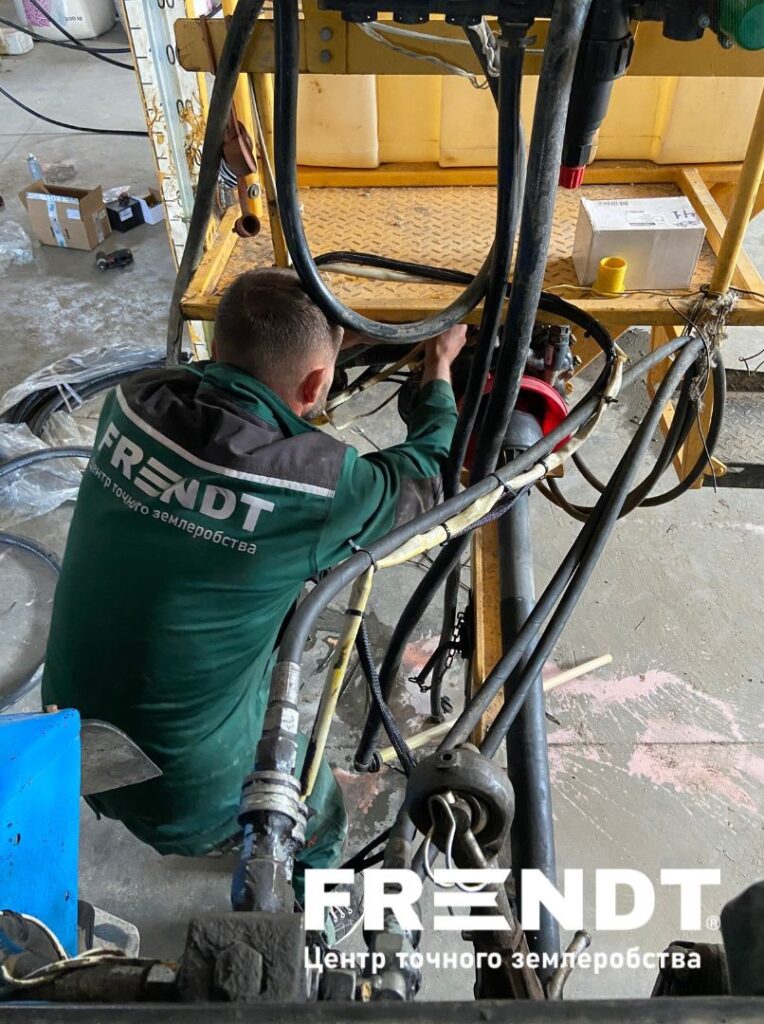
Controllers, sensors, valves, the terminal, and the wiring harness are integrated into the sprayer’s existing system.
Calibration
The following parameters are configured:
- implement geometry;
- section widths;
- nozzle positions;
- flow meter parameters;
- application rate;
- switch-on and switch-off points;
- other control parameters.
Correct valve response delay settings are particularly important. There is a certain amount of time between an electronic command and the actual start or stop of liquid flow, and the system must compensate for this delay.
Testing and Operator Training
Once installation is complete, the system is tested under working conditions, and the operator is provided with the necessary settings and guidance on how to operate the equipment.
Дизайн без назви – 1
What Electronic Modernisation Cannot Fix
Automation cannot compensate for failures or defects in the sprayer’s fundamental mechanical components.
Even the most accurate controller cannot correct:
- worn nozzles;
- clogged filters;
- unstable pump operation;
- damaged fluid lines;
- leaks;
- faulty valves;
- incorrect spray-tip selection;
- incorrect boom height.
Application accuracy therefore always depends on a combination of properly functioning mechanical components, correctly selected application components, electronic control, and proper machine setup.

Дизайн без назви – 1
Questions and Answers
How Can I Determine Whether It Makes Sense to Retrofit an Existing Sprayer Rather Than Buy a New One?
The first consideration should not be the machine’s year of manufacture, but its remaining technical service life. If the boom, frame, tank, pump, and hydraulic system are still in good working condition and the main limitation is an outdated application control system, retrofitting may be a perfectly rational solution.
The situation is different if the machine already requires substantial investment in mechanical repairs. In that case, the cost of repairs and electronic upgrades should be compared with the sprayer’s remaining service life.
The decision should therefore be based on a technical assessment rather than solely on the age or brand of the machine.
Is Individual Nozzle Control Always Better Than Section Control?
Not always. It provides a smaller controlled zone and potentially more precise shut-off, but the level of control should match the actual operating conditions.
If a farm mainly operates on large, regularly shaped fields, already has appropriately configured narrow sections, and has relatively few wedges, the difference between the two systems may be less significant.
Conversely, on complex field boundaries, wide booms, and fields with numerous turns and obstacles, the benefits of individual nozzle control become more substantial.
The relevant question is therefore not “Which system is more advanced?” but rather “How small does the controlled zone need to be for our fields?”
How Do You Determine the Right Number of Sections for a Sprayer?
There is no universally optimal number of sections.
It depends on:
- boom width;
- field shape;
- average pass length;
- number of wedges and obstacles;
- turning pattern;
- required accuracy;
- controller capabilities.
For example, the same number of sections on an 18-metre and a 36-metre boom would result in completely different widths for each controlled zone.
The key parameter to consider is therefore not only the number of sections, but primarily the actual width of each section.
Can a Sprayer with Manually Controlled Sections Be Converted to Automatic Control?
In many cases – yes.
To do so, the system must be able to control the flow of spray solution electronically. Depending on the design of the machine, this may require installing or replacing valves, a controller, flow meter, sensors, GNSS equipment, a terminal, and wiring.
This is why two sprayers that look very similar externally may require very different levels of retrofit work.
The first step is to determine how the sections are currently controlled and which actuating components are installed on the machine.
If the Tractor Already Has a GPS Display or Autosteer System, Is Another Terminal Required for the Sprayer?
Not necessarily.
If the existing display supports the required functions and can communicate with the sprayer controller, some of the equipment already installed can be retained.
However, the presence of a navigation display alone does not mean that it supports automatic section shut-off, application rate control, or communication with a specific controller.
For this reason, system design involves checking not only the display brand, but also:
- model;
- software version;
- available functions;
- connection interfaces;
- ISOBUS support;
- compatibility with the implement controller.
If a Sprayer Has ISOBUS, Does That Mean Section Control Will Work Automatically?
No. ISOBUS is a communication standard between the tractor, implement, and terminal, but the functions available depend on the hardware and software.
Automatic section control requires the system to support the relevant Task Controller Section Control functionality.
Therefore, the presence of an ISOBUS label on a sprayer or display does not in itself guarantee full functional compatibility.
For example, Hexagon’s current ISOBUS platform supports operation via Virtual Terminal and Task Controller, while the Section Control Kit is specifically designed for automated section management.
Is RTK Required for Individual Nozzle Control?
The principle of independently opening and closing individual nozzles does not automatically require the use of RTK. However, the smaller the controlled zone becomes, the more important positioning accuracy and repeatability are.
For a wide section, a small positioning offset may be less critical. When the system operates at the level of an individual nozzle, the positioning error can become comparable to the width of the controlled zone itself.
When selecting a GNSS solution, the following factors should therefore be considered:
- required accuracy;
- nozzle spacing;
- pass-to-pass repeatability;
- operation near field boundaries;
- availability of permanent tramlines;
- requirements of other precision agriculture operations.
RTK should therefore be considered not simply as an additional “option”, but as one component of the overall accuracy system.
Why Can Overlaps Still Occur After Automatic Section Control Has Been Installed?
Section Control significantly reduces the extent to which the result depends on manual switching, but this does not mean that overlap will be mathematically reduced to zero under all conditions.
The result is affected by:
- GNSS positioning accuracy;
- correct implement geometry settings;
- section width;
- valve opening and closing times;
- travel speed;
- driving trajectory;
- accuracy of the field boundary;
- permitted overlap settings.
For this reason, proper system calibration is just as important as physically installing and connecting the equipment.
Hexagon’s Sprayer Control system provides automated section control and flow regulation as the machine’s operating speed changes.
Why Is It Important to Configure Valve Opening and Closing Times?
Because the controller command and the actual start or stop of spray solution flow do not occur at exactly the same time.
The valve requires a certain amount of time to respond, and the spray solution also needs time to change its flow behaviour within the system.
If the system “assumes” that a section shuts off faster than it actually does, unnecessary overlap will remain in the field. If the timing parameter is set too far in the opposite direction, skips may occur.
Switch-on and switch-off delays are therefore critical calibration parameters.
Will Automatic Application Rate Control Solve Uneven Application?
Only the part of the problem associated with flow regulation.
The controller can adjust the flow according to travel speed and the target application rate, but it cannot compensate for every mechanical issue.
If the sprayer has:
- worn nozzles;
- clogged filters;
- unstable pump operation;
- leaks;
- incorrectly selected spray tips,
electronics alone will not make the application uniform.
This is why modernising the control system should be accompanied by an assessment of the sprayer’s actual mechanical condition.
What Happens to the Application Rate When the Tractor Speeds Up or Slows Down?
In an automatic application rate control system, the controller receives speed data and adjusts the spray solution flow accordingly.
If speed increases, the flow must also increase to maintain the same application rate per hectare. If the machine slows down, the flow must decrease.
However, the regulation range is not unlimited. It depends on pump capacity, nozzle operating range, pressure, and overall system parameters.
The target speed, application rate, and nozzle type must therefore be technically compatible with one another.
How Does an ARAG SELETRON Electronic Valve Differ from a Conventional Section Valve?
A conventional section valve controls the supply to a group of nozzles simultaneously.
SELETRON is installed directly at the nozzle holder and allows an individual nozzle to be controlled independently. The valve receives opening and closing commands via CAN-Bus and sends information about its status back to the system.
Because the actuator is positioned directly at the nozzle, control can be reduced from several metres of boom width to a much smaller operating zone.
What Happens If the GNSS Signal Is Lost During Operation?
This depends on the architecture and settings of the particular system.
GNSS is required to determine the implement’s position and make automatic decisions based on the coverage map. If the system loses a reliable position, automatic spatial section control cannot continue to operate in the same way as it does under normal positioning conditions.
For this reason, farms need to consider not only the receiver’s stated accuracy, but also signal stability and a clear procedure for the operator to follow if the signal is lost.
At the same time, functions that do not depend directly on positioning data may behave differently depending on the specific system configuration.
Can Prescription Maps Be Used After the Retrofit?
This depends on the controller, terminal, and software functions installed.
Modern systems can operate not only according to a simple “treated/not treated” principle, but can also use georeferenced data to vary the application rate.
Depending on the system configuration, Hexagon’s current implement-control solutions support application rate control, Section Control, and the use of application maps.
If a farm plans to move towards variable-rate application in the future, this should ideally be taken into account during the initial retrofit.
Can Section Control Be Installed First and Then Upgraded to Individual Nozzle Control Several Seasons Later?
Technically, such an upgrade is possible, but it is not equally straightforward with every system configuration.
This is why it is advisable to define the desired final system architecture before installing the basic solution.
If future expansion is planned from the outset, the controller, display, wiring, and other components can be selected accordingly. If the system was originally designed solely as a closed section-control solution, switching to a different control concept may require some of the equipment to be replaced.
What Does the Payback of a Sprayer Retrofit Actually Depend On?
Not only on the size of the farm.
At a minimum, the calculation should take into account:
seasonal treated area × actual overlap rate × average application cost per hectare.
The seasonal treated area can differ significantly from the size of the land bank.
For example, 2,000 hectares of land sprayed five times already represent approximately 10,000 hectares of completed operations during the season.
Potential results are also influenced by field shape, boom width, the existing number of sections, product costs, number of applications, and the farm’s current level of automation.
For this reason, it is more appropriate to calculate the potential return on investment for a specific farm rather than apply a single universal savings percentage.
What Information Is Required to Select a Sprayer Retrofit System?
To make a preliminary assessment of the feasibility and format of a retrofit, it is advisable to provide the following information:
- sprayer manufacturer and model;
- year of manufacture;
- machine type – mounted, trailed, or self-propelled;
- boom width;
- number of sections;
- number of nozzles and spacing between them;
- type of valves installed;
- flow meter model;
- existing controller;
- display model;
- availability of a GNSS receiver;
- availability of ISOBUS;
- preferred control type.
Photographs of the valve block, nozzle holders, terminal, connectors, and machine identification plate are also useful.
The more accurate the initial information is, the more precisely it can be determined which existing components can be retained, which need to be added, and which need to be replaced.