Sprayer Retrofitting: How Application Precision Turns into Farm Economics
Spraying in modern crop production has long ceased to be a purely technical operation. It is a complex agrotechnological process that directly determines the level of crop yield potential realization, the structure of production costs, the quality of the final product, and the degree of environmental pressure on the agroecosystem. Every liter of spray solution, every nozzle, and every meter of the sprayer’s pass today has a clearly measurable economic value.
For this very reason, more and more farms are moving away from the traditional “as-it-happens” application model and transitioning to controlled, high-precision spraying. One of the most rational ways to make this transition is to retrofit the existing sprayer. This solution makes it possible to significantly increase the technological level of the machine and the efficiency of its operation without investing in the purchase of new equipment.

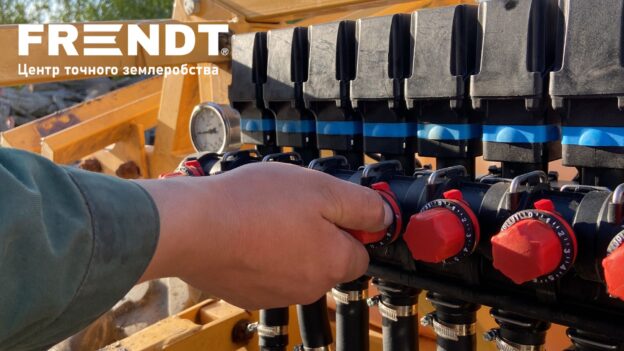
In the practice of FRENDT, three key formats of sprayer modernization are applied: section control, nozzle-by-nozzle control, and hybrid application control. Each of these approaches is aimed at minimizing product overuse, improving the uniformity of plant coverage with the spray solution, and achieving a stable, predictable production result.
Why does conventional spraying create hidden losses?
In traditional spraying, a significant part of quality depends on the operator’s attentiveness, visibility conditions, field relief, and the shape of field boundaries. Under real field conditions, this almost always leads to overlaps and double applications.
At first glance, they may seem barely noticeable. However, this is exactly where systemic losses are hidden:
- overuse of crop protection products;
- local exceedance of application rates;
- phytotoxic stress on the crop;
- uneven crop development;
- additional fuel consumption;
- extra operating time of machinery.
This problem is particularly acute in fields with complex shapes: wedges, curves, uneven boundaries, and headlands. In such areas, overlaps can reach 5–15% or more, which already means tens of thousands of hryvnias in unnecessary expenses per season.
Sprayer retrofitting shifts the process from the realm of “approximately accurate” to a format of systematically controlled precision, where every meter of the pass is managed by technology.

Section control: the first level of automation
Section control is a basic, yet very important step toward precision spraying. The sprayer boom is divided into separate sections, each of which can be automatically switched on or off.
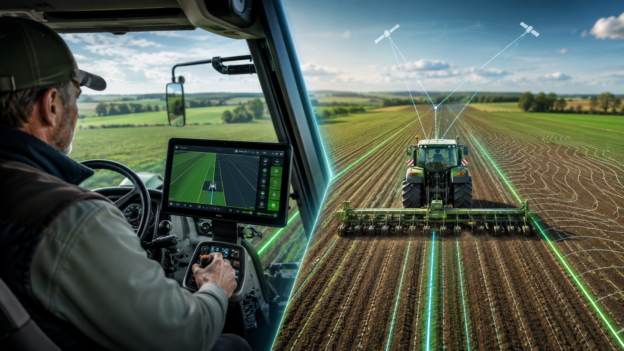
The navigation system records the areas of the field that have already been treated. When part of the boom enters an overlap zone, the corresponding section is switched off. Once it moves onto untreated area, it is switched on again.
The greatest benefit is observed precisely in complex zones – on headlands, in wedges, and along field edges. Where the operator previously had to react manually, automation now takes over.
Section control already makes it possible to significantly reduce product overuse. It is particularly effective for farms with medium-width booms and irregularly shaped fields. This is an optimal starting point for those who are just beginning their transition to precision farming.
Nozzle-by-nozzle control: precision at the level of each nozzle
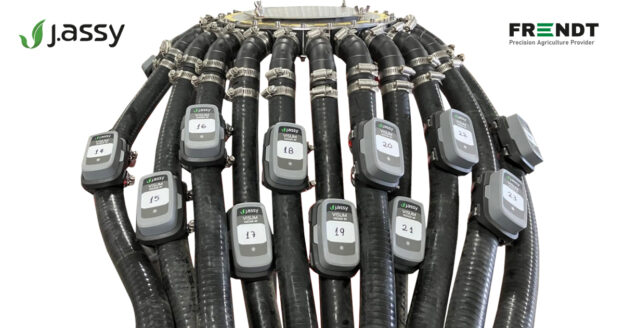
Nozzle-by-nozzle control is the highest level of precision available for retrofitted sprayers. In this case, control is performed not by sections, but by each nozzle individually.
The system analyzes the sprayer’s position in real time and switches off only those nozzles that enter an area that has already been treated. As a result, overlaps are reduced to the minimum possible level.
Technological advantages include:
- uniform coverage even on complex contours;
- precise adherence to the application rate;
- absence of local overdosing;
- stable application quality regardless of field relief.
This type of control ensures maximum savings in crop protection products. Even more importantly, it promotes uniform crop development, as plants receive the same load without “overdose” zones.
Hybrid control: a rational compromise
The hybrid system combines section control and nozzle-by-nozzle control. Part of the boom operates by sections, while the most critical zones are controlled with nozzle-level precision.
This solution fully justifies itself in cases of:
- large boom widths;
- phased equipment modernization;
- the need to optimize the investment budget.
The hybrid approach makes it possible to achieve high precision in the most problematic areas without the full cost of a complete nozzle-by-nozzle system. It is a flexible solution for farms striving for efficiency while taking a balanced approach to investments.
Crop protection products are one of the largest cost items during the season. Therefore, even 5-10% savings translate into a tangible financial result.
However, the impact of sprayer retrofitting is not limited to direct savings on products alone. Application precision ensures:
- uniform crop development;
- reduced stress on plants;
- better realization of genetic potential;
- more stable yields;
- a more predictable seasonal economy.
Thus, modernization creates long-term financial stability, not just one-time savings.
A retrofitted sprayer changes not only the equipment itself, but also the approach to work. Spraying ceases to be an operation heavily dependent on the “experience of the operator” and becomes part of a controlled digital system.
Result repeatability increases, the number of random errors decreases, and work at night or under difficult weather conditions becomes easier. This forms a new culture of precision within the farm.
A new self-propelled sprayer requires significant capital investment. Retrofitting makes it possible to:
- preserve existing equipment;
- achieve a modern level of precision;
- recover investments faster;
- modernize the machinery fleet gradually.
For many farms, this becomes the most rational strategy for technical development.

Section control, nozzle-by-nozzle control, and hybrid control are different tools serving one goal: the transition from approximate application to fully controlled precision.
Where there were once overlaps, overuse, and dependence on the human factor, control, uniformity, and economic predictability now appear. Sprayer retrofitting proves that modern efficiency begins not with a new machine, but with the right technological decisions for the equipment already working in the field.