The Carbon Footprint of Agribusiness: How Precision Farming Technologies Help Reduce It
Agriculture is one of the most vital yet carbon-intensive sectors of the global economy. According to FAO and IPCC estimates, the agricultural sector accounts for up to 31% of global greenhouse gas emissions, mainly carbon dioxide (CO₂), methane (CH₄), and nitrous oxide (N₂O).
The paradox is clear: the very industry that depends most on climate stability is also one of the key contributors to its disruption. Yet agriculture also has the greatest potential to reverse the trend – through the adoption of precision farming technologies.

How the Agricultural Carbon Footprint Is Formed
Greenhouse gas emissions in agriculture are generated at multiple stages of production:
- Soil cultivation – CO₂ release through oxidation of organic matter;
- Fertilizer application – N₂O emissions due to nitrogen excess;
- Machinery operation – fuel combustion, transportation, and inefficient resource use.
Traditional farming practices often intensify these processes: excessive fertilizer use, repeated tillage, and inefficient field routes lead to higher emissions and soil degradation.
Precision Farming Technologies as a Tool for Climate Transformation
Modern agribusiness is shifting toward a data-driven model – managing each field based on accurate data. This is more than just a trend; it’s a powerful strategy to cut carbon emissions without compromising yields.
1. RTK Navigation: Accuracy Within 2.5 cm
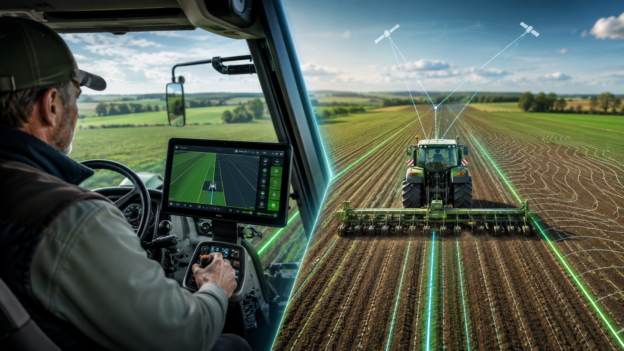
RTK (Real-Time Kinematic) technology ensures ultra-precise positioning of machinery during seeding, spraying, and harvesting.
Result: no overlaps or skips, optimized fuel use, and fewer passes across the field.
Every hectare cultivated without overlaps means dozens of liters of diesel saved – and therefore less CO₂ released into the atmosphere.
2. Yield Mapping: Turning Data into Efficiency
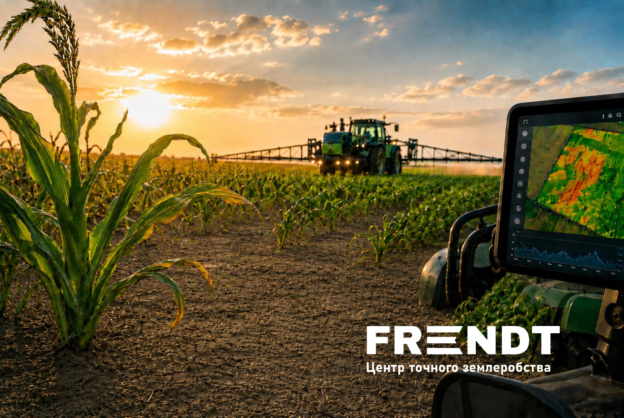
Yield-mapping systems allow farmers to visualize the productivity of each field zone.
Based on this data, prescription maps are generated – individual application schemes for fertilizers, seeds, and crop protection products.
These maps help:
- Reduce inputs in low-productivity zones;
- Focus resources where potential is highest;
- Minimize N₂O emissions caused by nitrogen overuse.
Analytics thus becomes a tool of environmentally conscious field management, where every ton of yield carries minimal carbon intensity.
3. Sprayer Retrofit: Chemistry Only Where Needed
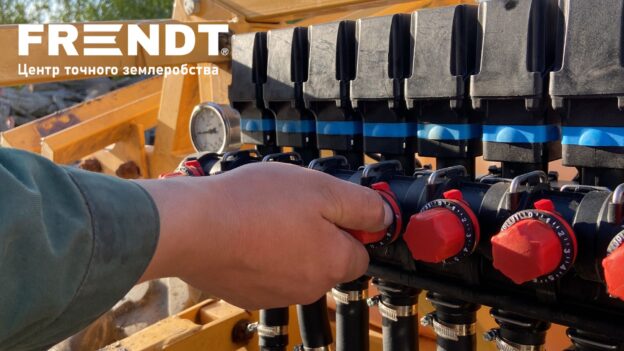
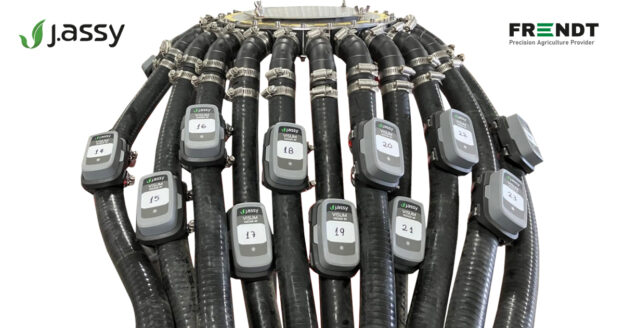
Modern precision-spraying systems – such as nozzle-by-nozzle or hybrid section control—reduce agrochemical use by 20-25%.
This means not only lower costs but also fewer toxic emissions into soil and air, reduced energy consumption, and a smaller carbon footprint.
4. Real-Time Analytics and Monitoring
Using telemetry, mobile weather stations, and sensors enables real-time control over soil condition, microclimate, moisture level, and field operations.
Farmers can now predict rather than react – planning fieldwork only when it’s truly necessary.
Reducing unnecessary machinery trips means hundreds of liters of fuel saved each season on every farm.
5. Electrification and Energy Efficiency of Machinery
The latest generation of agricultural equipment increasingly operates on hybrid or fully electric platforms.
When farms partially power their operations with renewable energy (solar panels, bioenergy), agriculture transitions from “carbon-intensive” to “carbon-balanced.”
The Numbers: When Precision Equals Sustainability
Analysts estimate that implementing precision agriculture technologies can:
- Cut fuel consumption by 10-15%;
- Reduce fertilizer use by 20-25%;
- Lower CO₂ emissions by up to 0.5 tons per hectare per season;
- Decrease pesticide use by up to 95% when using AI-driven systems such as Ecorobotix ARA.
When scaled to even 100,000 hectares, the economic and environmental impact becomes extraordinary.
The Ukrainian Context
In Ukraine – where more than 70% of the territory is agricultural land – the potential for carbon reduction is among the highest in Europe.
Here, precision farming not only boosts efficiency but also cultivates a new culture of responsible land management.
The adoption of RTK-based field surveying, digital boundaries, yield analytics, and automated nutrient systems is shaping a new generation of carbon-aware farmers.
This is the path toward making Ukraine’s agricultural sector not only profitable but also climate-neutral.
Precision Farming: The Path to Efficiency and Stability
Reducing the carbon footprint of agribusiness is not about limitation – it’s about efficiency, precision, and resilience.
Today, precision farming technologies are transforming farms into intelligent systems where every liter of fuel, every kilogram of fertilizer, and every drop of water is used only where it truly matters.
This is a new era of agriculture – where digitalization becomes a tool of ecology, and precision becomes a synonym for respect for the land.
Here lies the future of agribusiness: profitable, technological, and climate-responsible.