Transformation of Global Agriculture: The Digital Model of the Future
The agricultural system of the 21st century is experiencing a moment of truth. What for decades appeared to be a stable foundation of the global economy is now under pressure from processes that can no longer be ignored. Food security is no longer merely a matter of production volumes – it has become a matter of systemic resilience, efficiency, and precision in resource management.
The world is changing faster than the agricultural sector can adapt. It is precisely within this gap in pace that new tension emerges. It has become evident that the traditional model of extensive production growth no longer guarantees stability. It requires reconsideration.
The key to this reconsideration is technological transformation, with precision agriculture at its core.

Demographics as a Driver of Structural Change
As of early 2026, global demographic dynamics remain one of the key factors shaping long-term demand for resources and food. According to the annual World Population Prospects report, published on July 11, 2024, on World Population Day, the global population stood at 8.09 billion at the beginning of 2025. It is projected to grow to nearly 10 billion by the mid-2080s. This means not merely more consumers, but a more complex consumption model.
Rising incomes in many countries are altering dietary patterns. The share of animal-based products and processed foods is increasing, while supply chains are becoming more complex. Urbanization concentrates demand in megacities, where food provision depends on uninterrupted and predictable system performance.
Animal protein production requires significantly more resources than plant-based protein. Feed supply, water use, land allocation, and emissions increase proportionally with changes in dietary structure. Thus, demographic growth combined with evolving consumption habits does not simply increase demand – it multiplies pressure across the entire agricultural system.
This means pressure arises primarily within crop production, which provides the feed base for livestock. Crop farming becomes the critical efficiency point: the stability of protein production as a whole depends on the yields of grain and oilseed crops.
Under such conditions, the agricultural sector can no longer afford to operate “on average” or lose resources due to operational inaccuracies. A model is needed that ensures maximum return per hectare, per liter of fuel, and per ton of fertilizer. This is where precision agriculture shifts from innovation to strategic necessity.
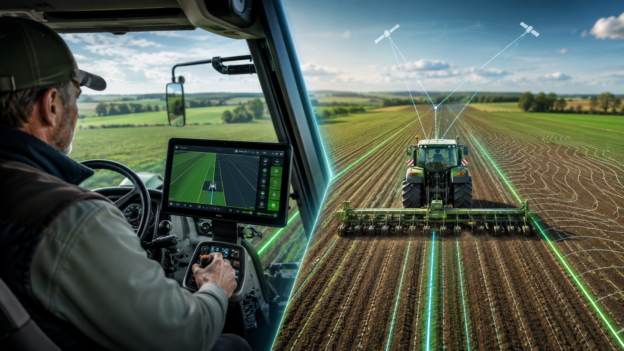
Another structural challenge is the shrinking agricultural workforce. Young people are moving to cities, and the average age of farmers is rising. Efficiency can no longer rely solely on human labor. Production must compensate for labor shortages through automation, navigation systems, analytics, and digital management platforms – all integral elements of precision agriculture.
Resource Limits: Land and Water Are Not Infinite
Arable land per capita continues to decline. A significant portion of agricultural land has already undergone degradation due to erosion, nutrient imbalance, and excessive anthropogenic pressure.
Historically, expansion of cultivated areas addressed this challenge. Today, that reserve is largely exhausted. Expanding into new territories increasingly means the loss of natural ecosystems.
Water resources are also under strain. Billions live in water-scarce regions. Irrigation systems require modernization, and every liter of water must be used efficiently.
Inefficient fertilizer application, monocropping, and crop rotation violations reduce long-term soil productivity. Short-term yield gains often come at the expense of future losses.
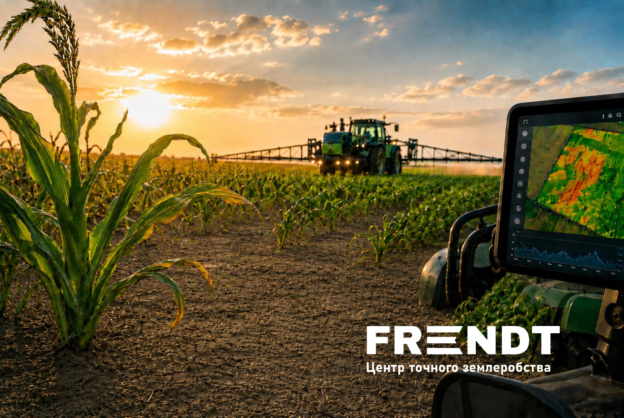
In this context, precision agriculture becomes a tool for resource preservation. Variable-rate application, yield mapping, and zone-based field management improve economic efficiency while minimizing soil degradation. It represents a shift from uniform impact to targeted management.
Climate Turbulence
Climate change has become a daily management factor in agribusiness. Irregular precipitation, rising temperatures, and extreme weather events create a new zone of uncertainty.
The traditional “sow and harvest” approach no longer guarantees results. Flexibility, rapid response, and real-time data analysis are required.
Precision agriculture enables:
– optimized operational timing;
– minimized overlaps and skips;
– reduced losses under stress conditions;
– data-driven decision-making.
Climate instability increases the need for predictability – and predictability is delivered by technology.
The Paradox of Overproduction
The world simultaneously faces hunger and massive food waste. Part of production never reaches consumers due to systemic inefficiencies.
This represents wasted land, water, and energy. In a resource-constrained world, this becomes critical.
Optimization strengthens the case for digitalization. Precision agriculture minimizes overuse, reduces excess input application, and increases yield predictability. Efficiency begins with precision.
Social Vulnerability in the Global Production System
Millions remain in poverty; hundreds of millions suffer from undernourishment. Food insecurity has a deep social dimension.
Simply expanding acreage or uncontrolled production growth is not a solution. A system is required that produces more with fewer resources and lower environmental impact.
Technology becomes not merely an economic tool but a stabilizing global factor.
A New Paradigm: From Quantity to Precision
Modern challenges are interconnected. Population growth increases pressure on resources. Resource depletion complicates climate adaptation. Inefficiencies in distribution deepen social imbalance.
Quantitative expansion is no longer sufficient. A new paradigm is required – focused on precision, efficiency, analytics, and systemic management.
Precision agriculture forms this paradigm. It enables:
– zone-specific field management;
– centimeter-level resource control;
– operation under limited visibility and climatic instability;
– increased economic return per hectare.
The future of agriculture will not be defined by acreage, but by the ability to integrate technology into management systems.
The world faces a choice: continue inertia or transition to technologically controlled production. For farmers planning decades ahead, the choice is evident.
The future belongs to technology.
And the technological foundation of modern agribusiness is precision agriculture.