UAN + Digital: How to Extract Maximum Value from Every Liter of Nitrogen
Editorial note:
Rising fertilizer prices are forcing farmers to account for every dollar spent. But are we truly saving money simply by reducing application rates? Our experience shows that the future lies not in cutting inputs, but in mathematically precise resource distribution.

Technological Breakthrough: Why UAN?
If granular ammonium nitrate is a form of “emergency care,” then UAN (Urea–Ammonium Nitrate solution) represents a balanced diet for crops.
The presence of three nitrogen forms – nitrate, ammonium, and amide – ensures both an immediate plant response and a prolonged nutrient supply lasting several weeks.
Within precision agriculture systems, UAN offers several advantages over granular fertilizers:
- Homogeneity: The liquid form enables extremely uniform distribution of the active ingredient.
- Flexible dosing: Modern sprayers can adjust the application rate within milliseconds.
- Synergy with crop protection products: UAN can be co-applied with micronutrients or pesticides, provided compatibility requirements are met.
However, the key advantage of UAN in precision agriculture lies in its physical stability. Liquid fertilizers allow the sprayer control system to adjust dosage instantly, without the inertia characteristic of granular fertilizer spreaders.
Deep Dive into VRA (Variable Rate Application)
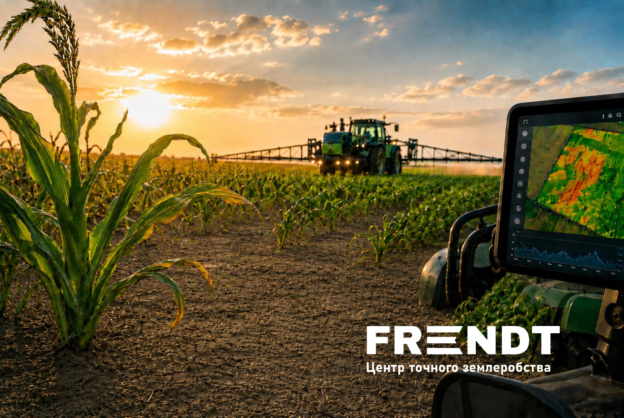
Variable Rate Application (VRA) replaces a fixed application rate (for example, 200 L/ha) with prescription maps.
- Analysis: Using satellite imagery (NDVI index), topographic maps, and soil analysis, the field is divided into productivity zones.
- Execution: The sprayer’s onboard computer reads GPS coordinates and automatically adjusts pressure and flow rate.
Result: Fertilizer savings on low-productivity or oversupplied zones reach 10-15% without yield reduction.
“Equalization” Strategy vs. “Maximization” Strategy
When creating a prescription map, the farmer must choose a fertilization philosophy.
1. Compensation Model: Higher nitrogen rates are applied to weak zones (low NDVI) to balance crop development across the field.
This strategy is effective in fields with low spatial variability.
2. Intensive Model: Nitrogen is applied where crops have the highest capacity to convert nutrients into yield.
On problematic areas (such as saline patches, waterlogged soils, sandy lenses) nitrogen rates are reduced to a minimum, since nutrients would likely be leached without increasing yield.
Expert tip: Use historical yield maps from the last 3–5 seasons.
If a specific zone consistently produces low yields regardless of rainfall, avoid wasting fertilizer inputs there.
Overlap Control (Section Control)
UAN requires high application precision, as double application in overlap zones may cause: foliar burn, lodging. Automatic section control or individual nozzle control completely eliminates this issue in headlands and irregular field shapes.
UAN and Crop Growth Stages (BBCH Scale)
Within precision farming systems, UAN applications must be carefully synchronized with crop development stages, since the window between effective nutrition and phytotoxicity is extremely narrow.
Below are agronomic recommendations based on the BBCH growth scale.
1. Winter Wheat: Managing Yield Components
In wheat, UAN is typically applied during three critical growth stages.
– BBCH 21-29 (Tillering):
- Objective: Increase the number of productive tillers.
- Precision approach: NDVI maps are used to fertilize zones with low tillering intensity.
- Application method: Broadcast UAN application is generally safe during this stage.
– BBCH 30-32 (Stem Elongation Initiation)
- Objective: Formation of spike length and grain number.
- Risk: The highest risk of foliar burn due to rapid leaf development.
- Precision solution: Variable-rate application using flow control systems.
- Important: Sprayer pressure should not exceed 2.0 bar.
– BBCH 37-51 (Flag Leaf Emergence – Heading)
- Objective: Improve grain protein and gluten content.
- Application method: Only diluted UAN should be applied (water ratio 1:3 or higher) or applied through drop hoses between rows to avoid damaging the flag leaf assimilation surface.
2. Corn: Synchronizing with Peak Nitrogen Demand
Corn absorbs up to 80% of its nitrogen during the period of rapid vegetative growth.
– BBCH 14-16 (4-6 leaf stage)
- Objective: Establishing ear size potential.
- Important warning: Foliar UAN application at this stage is extremely risky because fertilizer can accumulate in the leaf whorl, causing necrosis.
- Precision solution from Frendt: Installation of inter-row feeding systems (e.g., Y-Drop) enables UAN delivery directly to the root zone at BBCH 16–18, when satellite monitoring clearly reveals nitrogen deficiency.
– BBCH 30-34 (Stem Elongation)
- Objective: Maintain crop growth rate. Nitrogen is applied through variable-rate side-dressing based on yield maps.
3. Winter Rapeseed: Early Nitrogen Supply and Sulfur Balance
– BBCH 18-30 (Rosette – stem elongation)
- Objective: Stimulate branching.
- Feature: Rapeseed requires early nitrogen supply, therefore UAN should be applied immediately after vegetation resumes in spring.
- Technology recommendation: Frendt specialists recommend integrating weather stations, as rapeseed becomes highly sensitive to temperature at BBCH 30. Applications at temperatures above 15°C may damage the growth point.
– BBCH 50-55 (Inflorescence emergence)
Objective: Increase the number of pods. UAN can be applied only with large-droplet nozzles to prevent damage to flower buds.
4. Sunflower: Targeted Nitrogen Application
– BBCH 12-16 (2-6 true leaves)
- Objective: Provide nitrogen during head formation initiation.
- Method: Only root-zone application is recommended. Foliar UAN application in sunflower at BBCH 14 can lead to yield losses of up to 20% due to chemical stress.
- Digital precision: Using RTK autopilot systems with 2 cm accuracy, Frendt technology allows sprayers to move precisely between rows without damaging sunflower root systems, which are highly sensitive to mechanical injury.
Summary Table of BBCH Application Regulations
| Crop | Optimal Window (BBCH) | Maximum UAN Concentration | Frendt Technology |
| Wheat | 21-32 (main), 37-51 (quality) | Undiluted (up to BBCH 32), diluted (after BBCH 37) | NDVI-based VRA |
| Corn | 14-18 | Root-zone (100%) | RTK navigation |
| Rapeseed | 18-25 | Undiluted + sulfur | Section control |
| Sunflower | 12-14 | Inter-row only | Autopilot, 2.5 cm accuracy |
Technical Checklist for Precision UAN Application
To transform a digital prescription map into real results, machinery must be ready for the aggressive chemical environment of UAN.
1. Materials and Nozzles
UAN is corrosive.
All sprayer components in contact with the solution must be made of: corrosion-resistant polymers or stainless steel.
- For foliar feeding: Deflector nozzles are recommended. They create large droplets that roll off leaves instead of causing burns.
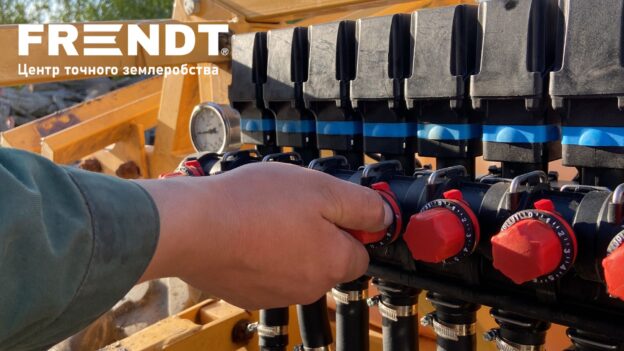
- For root-zone application: Extension hoses (drop hoses) allow UAN to be delivered directly into the row spacing while minimizing contact with plant foliage.
2. Density Correction
This is a critical point where even experienced operators make mistakes.
- Water density: 1.0 kg/L
- UAN-32 density: ≈1.32 kg/L
Important: Sprayers measure volume, while agronomists calculate mass of active ingredient. If the operator intends to apply 200 kg of UAN, but the terminal is set to water density, the result will be a 32% under-application. Always check the Density Factor setting in the sprayer terminal.
Application Quality Optimization
Precision farming requires perfect execution in the field.
Nozzle selection: UAN requires deflector or multi-orifice nozzles that produce large droplets, reducing drift and minimizing leaf burn.
Weather stations: Integrating sprayers with mobile weather stations allows operations to stop automatically if parameters such as wind speed or humidity exceed acceptable thresholds for liquid nitrogen application.
Economic and Environmental Impact
| Indicator | Conventional Method | Precision UAN Application |
| Nitrogen use efficiency | 40–60% | 70–85% |
| Fuel consumption | Baseline | 5–7% reduction (fewer field passes) |
| Environmental impact | Risk of nitrate leaching | Minimal groundwater impact |
Economics: How Much Does “Digital Agriculture” Earn?
Consider a 1,000-hectare farm.
- Overlap savings: With Section Control on irregular fields, fertilizer savings reach 5–8%. Given current UAN prices, this represents significant financial savings.
- Variable-rate optimization: Redistributing nitrogen from low-performing areas to productive zones can increase grain yields by 0.3–0.5 t/ha.
- Overall economic impact: The implementation of precision UAN application pays back the investment in equipment (RTK signal + VRA license) within a single season on farms larger than 400 hectares.
Transitioning to UAN combined with precision agriculture technologies represents a shift from intuitive agronomy to controlled crop production. Farmers stop spending money blindly and begin managing resources strategically. It is about controlling every liter of nitrogen. Partners such as FRENDT help Ukrainian farmers implement this transition efficiently, safely, and with clear economic justification.