Smart Application and Spraying: Saving Resources While Protecting the Environment
Field conditions are rarely uniform. Even within a single field boundary, soil structure, nutrient availability, moisture levels, topography, compaction, yield potential, and weed pressure can vary significantly. Yet many field operations are still performed using an averaged approach: one fertilizer rate, one spray rate, one strategy for the entire area.
This approach may simplify planning, but it is not always efficient in practice. Part of the input is applied where it is genuinely needed, while another part ends up in areas where its effect is limited or economically unjustified. As a result, farms pay not only for fertilizers, seeds, and crop protection products, but also for the inefficiency of their application.
That is why variable rate application and smart spraying are becoming increasingly important for farms that evaluate not only hectares, but also the efficiency of every field operation. This is not about “following the digitalization trend.” It is about a practical objective: applying inputs exactly where they make agronomic sense and can deliver economic value.

Why Uniform Application Creates Hidden Losses
Historically, uniform application was the simplest way to manage a field. Farms used an average rate and applied it across the entire area. Without detailed data on soil conditions, yield performance, or crop status, this approach appeared logical.
The problem arises when a field already demonstrates clear variability, while the technology remains identical for all zones.
For example, one part of the field may have sufficient phosphorus levels, while another suffers from deficiency. One area may retain moisture effectively, while another consistently experiences water stress. Some zones may show stable high productivity, while others are limited by topography, compaction, or historical management practices.
Applying a single rate across such variability inevitably becomes a compromise. In some zones, the farm under-applies. In others, it spends more than necessary. These losses are not always immediately visible because they are absorbed into the overall production cost structure.
Variable rate application helps move beyond this logic. It does not guarantee automatic savings in every field, but it provides the ability to manage resources with far greater precision.
What VRA Means in Practice
Variable Rate Application (VRA) is the process of adjusting the application rate of fertilizers, seeds, crop protection products, or other inputs depending on the specific area of the field.
In practice, VRA generally operates in two main ways.
The first approach is based on prescription maps. The farm prepares a digital map in advance, assigning a specific application rate to each management zone. These maps may rely on soil analysis results, yield maps, satellite imagery, topographic data, soil conductivity measurements, field history, and agronomic interpretation of this information. During operation, the machinery follows GPS coordinates and automatically adjusts the application rate.
The second approach relies on real-time sensor data. In this case, the system analyzes field conditions directly during operation: crop condition, biomass, weed presence, or other parameters. Application decisions are made not from a pre-created map, but based on the current condition of the field.
Both approaches share the same goal: eliminating unnecessary averaging from field operations.
Variable Rate Application and Overall Fertilizer Use
One of the most common misconceptions about VRA is reducing the concept solely to fertilizer savings. In reality, this is only one possible outcome.
Variable rate application may reduce total fertilizer use if part of the field already has sufficient nutrient availability. In other cases, however, the total volume may remain relatively unchanged. What changes is not necessarily the amount, but the distribution.
Zones with high yield potential and nutrient deficiencies may justify higher application rates. Areas with sufficient nutrient availability may require lower rates. Low-productivity zones may need a separate assessment to determine whether additional inputs are economically justified or whether the limiting factor is compaction, acidity, moisture availability, or soil structure.
VRA should not function as a mechanical “cost-cutting tool.” Its purpose is to help agronomists allocate resources where crops can actually utilize them efficiently. This is where the economic logic emerges: the farm does not simply buy less or more fertilizer – it gains a clearer understanding of where every kilogram truly creates value.
Environmental Benefits Begin with Avoiding Excessive Application
The environmental aspect of precision application is often described too generally. In practice, it is relatively straightforward: any input applied beyond crop requirements or outside the appropriate zone carries a higher risk of becoming a loss.
For fertilizers, this may result in leaching, surface runoff, uneven nutrient uptake, or accumulation in areas where it provides little agronomic benefit. For crop protection products, it may mean unnecessary chemical load on areas where the target pest or weed is absent or minimal.
Precision application does not eliminate the use of fertilizers or crop protection products. It makes their use more justified and targeted. For farms, this means fewer non-productive expenses. For the field, it means less unnecessary intervention. For the environment, it means a lower risk of nutrients or chemicals moving beyond the intended target zone.
Smart Spraying: Treating the Target, Not the Entire Field
Conventional spraying typically follows the principle of blanket application. If a field is scheduled for treatment, the product is applied across the entire area. However, weeds are rarely distributed uniformly enough to justify equal treatment of every square meter.
Smart spraying systems fundamentally change this approach. Cameras detect plants in the field, algorithms analyze the imagery, the system identifies weeds or other target objects, and nozzles activate only where treatment is necessary.
The key value is not merely the presence of artificial intelligence, but the outcome it delivers: the sprayer stops treating the field as one continuous surface and begins responding to specific targets.
This is especially valuable for herbicide applications. If weeds occupy only part of the field, there is no agronomic justification for spraying every crop plant and every square meter. Spot application allows farms to reduce spray solution volumes and minimize crop exposure to chemicals wherever technologically possible.
AI-powered sprayers should not be viewed as machines that automatically solve every crop protection challenge. Their real value lies in the ability to rapidly analyze field conditions, identify target objects, and manage spraying with extremely high precision.
The system detects a plant, compares it against a trained model, and decides whether to activate the nozzle. In such technologies, not only algorithms matter, but also camera quality, data processing speed, nozzle response accuracy, machine stability, boom height, lighting conditions, and the development stage of both crops and weeds.
A strong example of this approach is the ARA by Ecorobotix. The system analyzes the field in real time, distinguishes soil, crops, and weeds, and directs the product only onto identified targets. Thanks to ultra-high precision spraying, the system operates not across the entire field, but effectively at the level of an individual plant. According to the manufacturer, the spot spraying format reaches 6 × 6 cm, while crop protection product use can be reduced by up to 95% compared to blanket application.
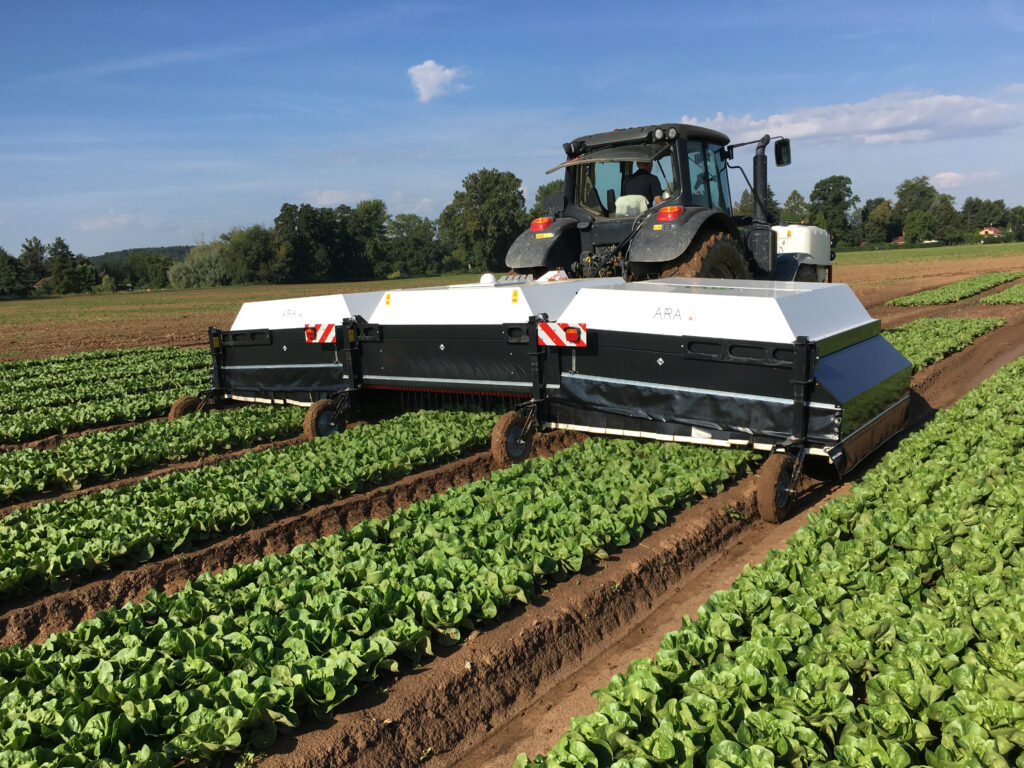
The economics of this approach are created in several ways. Farms can reduce crop protection product costs where spot application is possible, decrease unnecessary stress on crops, and gain greater control over operation quality. Modern systems record treated areas, actual nozzle activations, covered zones, and application patterns, allowing this data to be used for analysis and future planning.
Why High-Quality Data Is Essential for Effective VRA
Variable rate application is often mistakenly perceived as merely a machinery function. In reality, machinery is only the final stage. The decision itself must first be properly prepared.
VRA requires accurate input data: soil analysis, yield maps, field boundaries, satellite indices, topographic information, field history, and an understanding of limiting factors. This data must not only be collected, but also interpreted correctly.
If a prescription map is created formally, the machinery will execute a formal decision with perfect precision. This is one of the most dangerous mistakes in precision agriculture: high-precision execution cannot compensate for weak agronomic logic.
That is why VRA should begin not with the question, “Does our terminal support prescription maps?”, but rather, “What data are we using to justify different application rates?”
Who Benefits Most from These Technologies
Variable rate application and smart spraying are most valuable for farms where there is meaningful variability to manage.
This includes fields with pronounced soil heterogeneity, uneven yield history, problematic zones, irregular weed pressure, or high fertilizer and crop protection costs. These technologies are also especially relevant for farms already using RTK navigation, machinery capable of variable rate application, prescription maps, or data-driven management approaches.
Farm size matters, but it is not the only criterion. In some cases, a single highly variable field can demonstrate the value of VRA more clearly than a large area with relatively uniform conditions.
The key question is not, “Are we large enough for this technology?”, but rather, “Do we have a problem this technology can solve?”
Responsible Resource Use Is a Management Challenge
Fertilizers and crop protection products remain essential tools of modern agriculture. The issue is not eliminating them or mechanically reducing rates. The real challenge is removing unnecessary application where it provides no agronomic benefit.
Smart application and AI-powered spraying provide agronomists and technical managers with greater operational control. They enable decisions to be more closely aligned with actual field conditions, reduce non-productive costs, and improve documentation of completed operations.
For farms, this means practical savings and better operational management. For the environment, it means reduced excessive impact. For agricultural teams, it represents a transition from generalized standards toward more precise field-specific strategies.
Smart application and spraying do not make agronomy simpler. On the contrary, they require better data, more accurate decisions, and greater execution discipline.
VRA enables farms to manage soil variability and the differing potential of field zones more effectively. AI sprayers make it possible to target weeds and other objects with a level of precision that blanket application cannot achieve. Together, these technologies reduce the number of decisions made for the “average field” and move operations closer to the actual conditions of each specific location.
For farms, this is not a guarantee of instant savings, but a powerful tool for improving the management of costs, resources, and results. And as fertilizers, crop protection products, fuel, and operational mistakes become increasingly expensive, the ability to apply inputs not only at the correct rate, but also in the correct place, becomes far more valuable.